
International collaborative research in the Whittard Canyon aboard RV Celtic Explorer
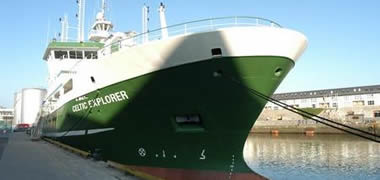
An international research team, led by scientists from NUI Galway, is currently exploring the Whittard Canyon deep-sea submarine canyon system in the North East Atlantic onboard the Marine Institute’s RV Celtic Explorer.
Researchers from Ireland, the UK, the USA and Germany are using the Institute’s ROV Holland I to study the diversity of deep-water animals and relate this to geology and ocean currents.
The Whittard Canyon system is at the continental margin approximately 250 miles SW of Cork, covers an area of 2000 square miles, and is home to vulnerable marine ecosystems of cold-water corals, deep-water oysters and file clams. But new research is also revealing a remarkable diversity and abundance of rare black corals, which are protected under international legislation.
“The extreme shape of submarine canyons seems to affect the water flow within them in such a way as to deliver nutrient rich waters to particular parts of the canyon system. This allows diverse ecosystems to flourish. Our research is attempting to understand these processes so that we can predict where the most vulnerable ecosystems are likely to occur and therefore ensure the environment is protected,” explained Dr Martin White of NUI Galway’s Ryan Institute, and the expedition’s chief scientist.
According to Dr Louise Allcock, also of NUI Galway’s Ryan Institute, “Black corals are particularly vulnerable to any sort of impact. They grow extremely slowly and dating studies have shown that some species live for thousands of years.”
The Whittard Canyon system is huge, with meandering branches extending over an area of more than 80 by 20 miles. Mapping the system, much of which is in depths below 1500m, to detect vulnerable species is difficult. Therefore the team hopes that the new data will reveal the factors that determine which species occur where.
ROV Holland I provides a way of sampling deep-sea animals without impacting the ecosystem. The team is also providing deep-sea sponge samples to scientists searching for novel pharmaceutical compounds. If the chemists find interesting compounds such as antibacterial and other pharmaceutical properties in the sponges, they will aim to work out how to synthesize them in the laboratory. This is the first step in the production of new drugs.
The scientists are blogging about their experiences and discoveries aboard RV Celtic Explorer throughout the survey (June 6th – 21st) on the blog scientistsatsea.blogspot.ie and on twitter via the hashtag #ce14009
The research survey is carried out under the Sea Change strategy with the support of the Marine Institute, funded under the Marine Research Sub-Programme by the Irish Government.
-Ends-
Related News
24 November 2026
University of Galway launches 2026/27 Gaelic Games seaso
23 November 2026
New award and scholarships in honour of UN Special Rapporteur Francesca Albanese
18 November 2026
Déanann Ollscoil na Gaillimhe ceiliúradh ar chúigear a bhfuil Céim Oinigh le bronnadh orthu
18 November 2026
Two University of Galway academics named among world’s top researchers
18 November 2026
University of Galway celebrates five Honorary Degree recipients