-
Courses
Courses
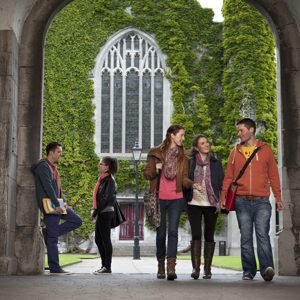
Choosing a course is one of the most important decisions you'll ever make! View our courses and see what our students and lecturers have to say about the courses you are interested in at the links below.
-
University Life

University Life
Each year more than 4,000 choose University of Galway as their University of choice. Find out what life at University of Galway is all about here.
-
About University of Galway

About University of Galway
Since 1845, University of Galway has been sharing the highest quality teaching and research with Ireland and the world. Find out what makes our University so special – from our distinguished history to the latest news and campus developments.
-
Colleges & Schools
Colleges & Schools
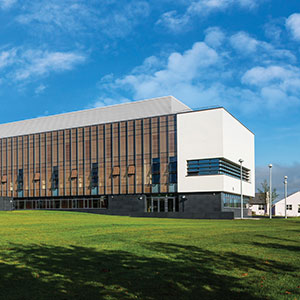
University of Galway has earned international recognition as a research-led university with a commitment to top quality teaching across a range of key areas of expertise.
-
Research & Innovation

Research & Innovation
University of Galway’s vibrant research community take on some of the most pressing challenges of our times.
-
Business & Industry
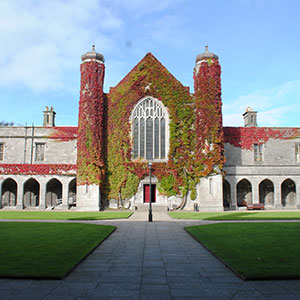
Guiding Breakthrough Research at University of Galway
We explore and facilitate commercial opportunities for the research community at University of Galway, as well as facilitating industry partnership.
-
Alumni & Friends

Alumni & Friends
There are 128,000 University of Galway alumni worldwide. Stay connected to your alumni community! Join our social networks and update your details online.
-
Community Engagement
Community Engagement
At University of Galway, we believe that the best learning takes place when you apply what you learn in a real world context. That's why many of our courses include work placements or community projects.
 Accessibility & Language
Discipline of Philosophy Speakers Series
Photography, Poignancy and Negative Education
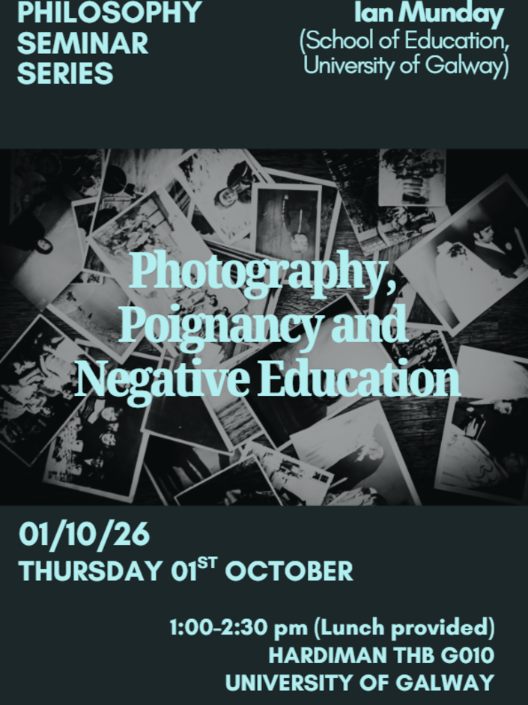
Philosophy guest lecture by Dr Ian Munday
Oct
01
2026
Posted: 08:21 IST
Discipline of Philosophy presents "Photography, Poignancy and Negative Education" by Dr Ian Munday (University of Galway)
Abstract:
In this paper I consider how our experiences of photographs may be educative in ways which are intimately bound up with negation and death. To do this I draw on Roland Barthes’s seminal work Camera Lucida where these issues are handled in some depth. Barthes’ argues that the photograph conjures death: ‘The object ‘has been here’ yet is ‘immediately separated; it has been absolutely irrefutably present, and yet already deferred’. Following this claim, Barthes, draws on two central concepts which denote our relationship with photographs – studium and punctum. Barthes explicitly associates the studium with education presenting it in lukewarm terms where students of the photograph become familiar with cultural meanings intended by the photographer/teacher. In contrast, the punctum refers to the unintended spectral details in photographs which pierce through the studium and connect with our innermost desires. Following Derrida’s deconstructive reading of Barthes, which may align with the latter’s intentions, I argue for a negative education in which study is made poignant through the metonymic relationship between studium and punctum. Lastly I consider how this this relationship may not just be applicable to our experiences with photographs but may be a feature of textuality in general.
Bio:
Ian Munday is Senior Lecturer in Educational Philosophy in the School of Education at the University of Galway. Ian’s research activities testify to an engagement with philosophical issues in education, particularly those concerned with teaching and learning. His publications have tended to focus on various approaches to performatives and performativities and demonstrate the significance of these ideas for education. The themes explored in these terms include race, gender, authority and the language of schooling. Here, philosophical ideas are treated in regard to their relevance to the details of educational practice. Ian has also written on the themes of creativity and problem-solving.