-
Courses

Courses
Choosing a course is one of the most important decisions you'll ever make! View our courses and see what our students and lecturers have to say about the courses you are interested in at the links below.
-
University Life

University Life
Each year more than 4,000 choose University of Galway as their University of choice. Find out what life at University of Galway is all about here.
-
About University of Galway

About University of Galway
Since 1845, University of Galway has been sharing the highest quality teaching and research with Ireland and the world. Find out what makes our University so special – from our distinguished history to the latest news and campus developments.
-
Colleges & Schools

Colleges & Schools
University of Galway has earned international recognition as a research-led university with a commitment to top quality teaching across a range of key areas of expertise.
-
Research & Innovation

Research & Innovation
University of Galway’s vibrant research community take on some of the most pressing challenges of our times.
-
Business & Industry
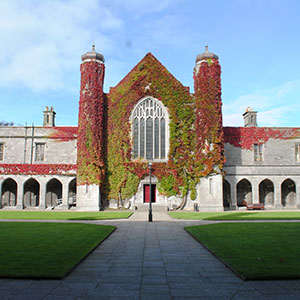
Guiding Breakthrough Research at University of Galway
We explore and facilitate commercial opportunities for the research community at University of Galway, as well as facilitating industry partnership.
-
Alumni & Friends

Alumni & Friends
There are 128,000 University of Galway alumni worldwide. Stay connected to your alumni community! Join our social networks and update your details online.
-
Community Engagement

Community Engagement
At University of Galway, we believe that the best learning takes place when you apply what you learn in a real world context. That's why many of our courses include work placements or community projects.
 Accessibility & Language
International Students
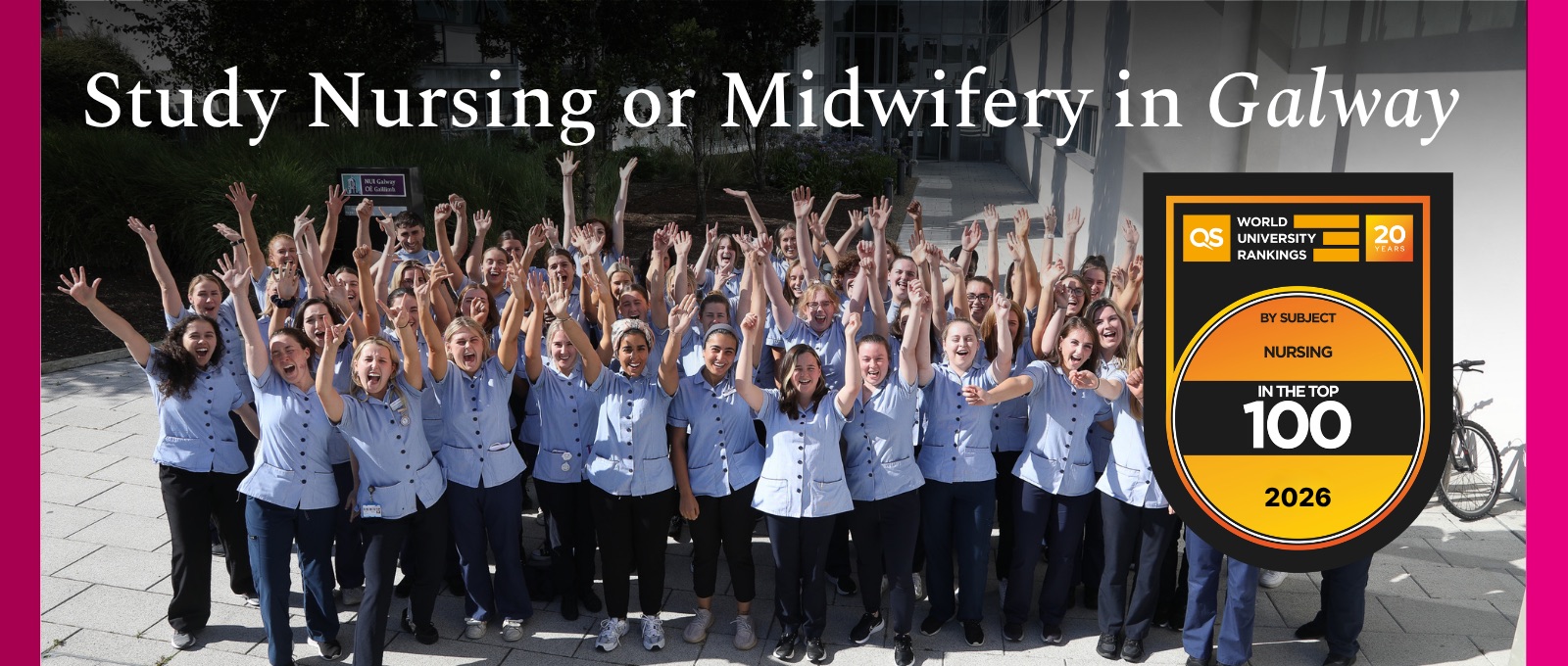
The School of Nursing, Midwifery & Evidence Science at University of Galway welcomes students from Ireland, Europe and around the world.
Our four-year undergraduate nursing and midwifery degrees combine university learning with extensive clinical education, preparing students for professional practice in a changing healthcare environment.
Located in Galway on Ireland's west coast and connected with hospital, community and specialist healthcare services across the region, our students learn in both academic and real healthcare environments throughout their degree.
International students can apply to study General Nursing, Mental Health Nursing or Midwifery at University of Galway.
Undergraduate Degrees Open to International Applicants
International applicants can apply to all three of our undergraduate professional programmes.
Each programme is a four-year, full-time degree combining academic study, practical skills development and clinical education.
Select a programme below to explore the curriculum, placements, entry requirements, fees and application information in more detail.
| Programme | Code | Duration | Professional pathway |
|---|---|---|---|
| Bachelor of Nursing Science (General) | GY515 | 4 years | General Nursing |
| Bachelor of Nursing Science (Mental Health) | GY516 | 4 years | Mental Health Nursing |
| Bachelor of Midwifery Science | GY517 | 4 years | Midwifery |
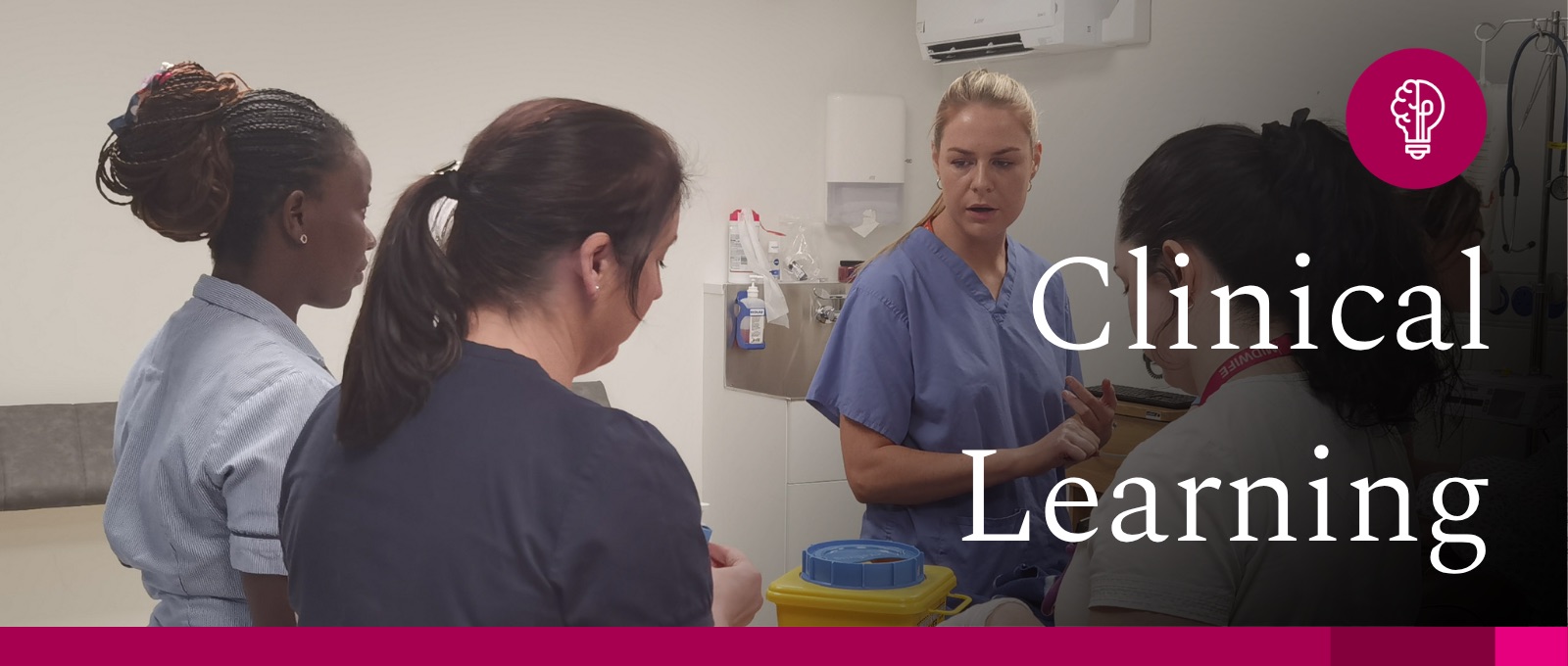
Learn Through Clinical Practice
Clinical education is central to our nursing and midwifery degrees.
Alongside your academic studies, you will develop practical and professional skills in our teaching and clinical skills facilities before applying your learning in real healthcare environments.
Clinical placements are integrated throughout the undergraduate programmes and provide experience across relevant hospital, community and specialist healthcare settings. Depending on your programme, placements may take place in Galway and at partner healthcare sites elsewhere in the West and North West of Ireland.
Students are supported in practice by registered nurses or midwives, Clinical Placement Coordinators and University academic staff.
Undergraduate nursing and midwifery programmes also include a paid clinical internship (worth up to €21K) towards the end of the degree, allowing students to consolidate their learning as they progress towards professional practice.
Because placements are an essential part of the degree, students should be prepared to travel to different clinical sites and to participate in the working patterns associated with professional healthcare practice.
Your Professional Qualification and Career
Nursing and midwifery are regulated professions in Ireland.
The Nursing and Midwifery Board of Ireland (NMBI) is the professional regulator for nurses and midwives practising in Ireland.
Following successful completion of the relevant University of Galway undergraduate programme, graduates are eligible to apply for registration with NMBI in the appropriate professional division:
- General Nursing graduates can apply for registration in the General Nursing Division.
- Mental Health Nursing graduates can apply for registration in the Psychiatric Nursing Division.
- Midwifery graduates can apply for registration in the Midwives Division.
A nursing or midwifery degree can lead to opportunities across clinical practice, specialist services, community healthcare, management and leadership, education, research and further postgraduate study.
Planning to work outside Ireland after graduation?
Professional registration requirements differ between countries. If you intend to practise outside Ireland following graduation, you should check the requirements of the nursing or midwifery regulatory authority in the country in which you intend to work.
Important note for international applicants:
Completion of an Irish professional degree does not automatically guarantee registration in another jurisdiction.
How to Apply
Irish, EU/EFTA and UK Applicants
Applications from Irish and European applicants, including EU/EFTA and UK applicants, are normally made through the Central Applications Office (CAO).
You should check the entry requirements for your qualification as well as the specific requirements of the nursing or midwifery programme to which you are applying.
The normal CAO application deadline is 1 February. Late applications may be possible until 1 May, subject to the rules and restrictions set out by CAO.
Admission is competitive and meeting the minimum academic requirements does not guarantee an offer of a place.
EU/EFTA Undergraduate Admissions
Non-EU International Applicants
Students applying for a full undergraduate degree who are liable for full non-EU tuition fees should apply directly to University of Galway through the international undergraduate application system.
Applications open on 1st October each year for entry the following September.
For September 2027 entry, applications open on 1st October 2026.
Applications are considered on a rolling basis and programmes may close once available places have been filled. We therefore strongly recommend applying as early as possible.
International applicants to General Nursing, Mental Health Nursing and Midwifery must meet the School's academic, subject and English-language requirements and are also required to complete an admissions interview.
You will be required to provide supporting academic documentation as part of your application. The documentation required will depend on your educational system and qualification.
Check the International Entry Requirements section below before applying.
International Entry Requirements
International applicants must meet the academic, subject and English-language requirements for their chosen nursing or midwifery programme.
The minimum international academic requirements are the same across our three undergraduate programmes. However, meeting the minimum entry requirements does not guarantee an offer of a place. Nursing and Midwifery are competitive programmes with a limited number of places available.
Applicants presenting qualifications from outside Ireland should also check the University's country-specific guidance to understand how their secondary-school qualification is assessed.
| Programme | Global Galway Minimum | International Baccalaureate | Cambridge A Levels | English Language |
|---|---|---|---|---|
| Bachelor of Nursing Science (General) – GY515 | Band III – 75% or above | 32–33 points | ABB | IELTS 7.0 overall, with no band below 6.5 |
| Bachelor of Nursing Science (Mental Health) – GY516 | Band III – 75% or above | 32–33 points | ABB | IELTS 7.0 overall, with no band below 6.5 |
| Bachelor of Midwifery Science – GY517 | Band III – 75% or above | 32–33 points | ABB | IELTS 7.0 overall, with no band below 6.5 |
Required School Subjects
In addition to meeting the overall academic standard, applicants must have appropriate secondary-school study in the following areas:
- English or Irish (Requirement waived for Non-EU applicants; Non-EU students still must satisfy the English Language Requirements to be considered for the programme)
- Mathematics
- A laboratory science subject, such as Biology, Chemistry, Physics, Physics and Chemistry, or Agricultural Science
- Three other recognised subjects
International equivalents will be assessed according to the qualification and education system in which you have studied.
If you are unsure whether your subjects meet the programme requirements, please check the University's country-specific entry requirements before applying.
English Language Requirements
A high standard of English is required because students must communicate effectively and safely in both academic and clinical environments.
For the undergraduate General Nursing, Mental Health Nursing and Midwifery programmes, the current English-language requirement is:
IELTS Academic: 7.0 overall, with no individual component below 6.5, or an accepted equivalent qualification.
Applicants may satisfy the English-language requirement through other recognised qualifications where permitted under University policy. Please consult the University's current English Language Requirements before applying.
Admissions Interview
International applicants from outside of the EU who satisfy the relevant academic requirements are required to complete an admissions interview as part of the selection process.
The interview provides the School with an opportunity to assess the applicant's suitability and preparedness for professional nursing or midwifery education.
Applicants will receive further information regarding the interview process if they progress to this stage of their application.
The interview requirement applies across General Nursing, Mental Health Nursing and Midwifery in the approved entry-requirements table.
Important: Minimum Entry Requirements
The requirements shown above are minimum requirements for consideration.
Meeting the academic, subject and English-language requirements does not guarantee admission. Places on Nursing and Midwifery programmes are limited and applications are considered as part of a competitive admissions process.
Applicants are encouraged to submit their complete application as early as possible. After receiving an offer, they should aim to finalize their registration promptly to secure their place and allow enough time for their visa application.
Fees and Funding
The fees you pay depend on your assessed fee status and the academic year in which you begin your studies.
EU Applicants
Eligible students may qualify for Ireland's Free Fees Initiative, under which the State pays the tuition element of eligible undergraduate fees.
Students may still be required to pay the applicable student contribution and University levy.
Some students may also be eligible for financial support through SUSI, Ireland's national student grant scheme.
Eligibility for EU fees, the Free Fees Initiative and student financial support depends on specific nationality, residency and other criteria. Applicants should therefore check their individual eligibility rather than assuming fee status based on nationality alone.
Non-EU Applicants
Students assessed as liable for non-EU tuition fees should check the fee published for their programme and year of entry.
Non-EU tuition fees are charged on an annual basis. Students should also budget for living costs including accommodation, food, transport, health insurance where required and other personal expenses.
Fees may change between academic years, so applicants should always consult the University's current Fees Office information before accepting an offer.
Please note the School of Nursing, Midwifery and Evidence Science does not provide at present any partial/full scholarship for our undergraduate programmes. Students are expected to pay all fees in full for the duration of the programme.
Preparing for Clinical Placement
Nursing and midwifery students work directly with patients and service users. For this reason, additional professional and health requirements apply before students can participate in clinical placements.
International students should be particularly aware of these requirements and begin preparing relevant documentation as early as possible.
Health Assessment, Vaccination and Screening
All nursing and midwifery students are required to complete the University's pre-placement health assessment process.
Registered students must participate in the School of Nursing, Midwifery & Evidence Science Vaccination and Screening Programme, which is delivered in collaboration with our clinical partners.
Access to clinical placements is essential to successful completion of the programme. Students must therefore meet the relevant health, screening and clinical requirements necessary to participate safely in professional practice.
Further instructions are provided to students as part of the pre-placement process.
Garda Vetting and Overseas Police Clearance
Students must satisfy the University's Garda Vetting requirements before undertaking clinical placements.
If you have lived outside the Republic of Ireland or Northern Ireland for six months or more since the age of 16, you will also be required to provide a Police Clearance Certificate from each relevant country of residence.
Police clearance documents can take considerable time to obtain. International students are therefore strongly advised to begin this process as early as possible when instructed by the University.
Travel and Placement Locations
Clinical placements do not take place exclusively on the University campus or within Galway City.
Depending on your programme, you may undertake placements in hospitals, community services or specialist healthcare settings elsewhere in the West and North West of Ireland.
Students should therefore be prepared to travel to placement locations and should take this into account when planning accommodation, transport and living costs.
Placement arrangements vary according to programme requirements and the clinical experience required at each stage of the degree.

Coming to Galway
Moving to another country to begin a professional healthcare degree is a significant transition.
University of Galway provides international students with information and support to help them prepare for studying and living in Ireland.
Global Galway provides guidance on areas including:
- Immigration and student visas
- Health insurance
- Pre-arrival preparation
- Living in Ireland
- International student support
The University also provides information and support in relation to accommodation, student wellbeing, academic development, clubs, societies and life on campus.
Accommodation
Demand for student accommodation in Galway is high. Students moving to Galway should begin researching accommodation as early as possible and should consider both University residences and appropriate private accommodation.
Visas and Immigration
Students from EU and EEA member states do not require a visa to study in Ireland.
Non-EU students must comply with the immigration requirements that apply to their nationality and circumstances. Visa-required students should begin preparing their application as early as possible after accepting an offer.
Immigration regulations can change, so students should always follow the latest guidance provided by the Irish immigration authorities and the University of Galway.
Looking for a Short-Term International Experience?
Not every international student wants to complete a full four-year degree at University of Galway.
The School also supports selected opportunities for students and healthcare professionals who wish to engage with University of Galway for a shorter period of study.
Available options and eligibility requirements differ considerably depending on the type of study and professional requirements involved.
Explore our International Opportunities section for information on currently available routes.

Start Your Journey at University of Galway
Explore the programme that matches the healthcare career you want to build.
Bachelor of Nursing Science (General) – GY515
Develop the knowledge, clinical skills and professional competencies required for General Nursing practice.
Bachelor of Nursing Science (Mental Health) – GY516
Prepare for a professional career supporting mental health, recovery and wellbeing.
Bachelor of Midwifery Science – GY517
Prepare to provide safe, evidence-based and person-centred midwifery care to women, babies and families.
Applying from outside the EU?
View the University's Non-EU Undergraduate Application information for current entry requirements, documentation and application guidance.
Have a question about the School?
School of Nursing, Midwifery & Evidence Science
University of Galway
Áras Moyola
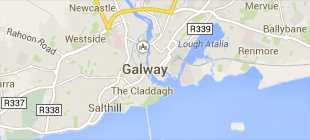
Galway, Ireland