-
Courses

Courses
Choosing a course is one of the most important decisions you'll ever make! View our courses and see what our students and lecturers have to say about the courses you are interested in at the links below.
-
University Life

University Life
Each year more than 4,000 choose University of Galway as their University of choice. Find out what life at University of Galway is all about here.
-
About University of Galway

About University of Galway
Since 1845, University of Galway has been sharing the highest quality teaching and research with Ireland and the world. Find out what makes our University so special – from our distinguished history to the latest news and campus developments.
-
Colleges & Schools
Colleges & Schools
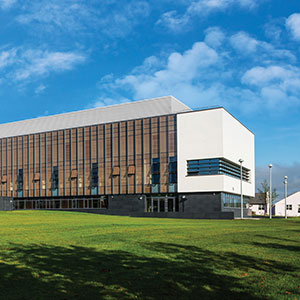
University of Galway has earned international recognition as a research-led university with a commitment to top quality teaching across a range of key areas of expertise.
-
Research & Innovation

Research & Innovation
University of Galway’s vibrant research community take on some of the most pressing challenges of our times.
-
Business & Industry
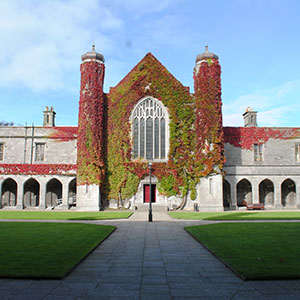
Guiding Breakthrough Research at University of Galway
We explore and facilitate commercial opportunities for the research community at University of Galway, as well as facilitating industry partnership.
-
Alumni & Friends
Alumni & Friends
There are 128,000 University of Galway alumni worldwide. Stay connected to your alumni community! Join our social networks and update your details online.
-
Community Engagement
Community Engagement
At University of Galway, we believe that the best learning takes place when you apply what you learn in a real world context. That's why many of our courses include work placements or community projects.
 Accessibility & Language
Tab 1 Content
PhD Researcher Larissa Lima presents comparative research on female imprisonment at international conferences
Oct
01
2026
Posted: 12:20 IST
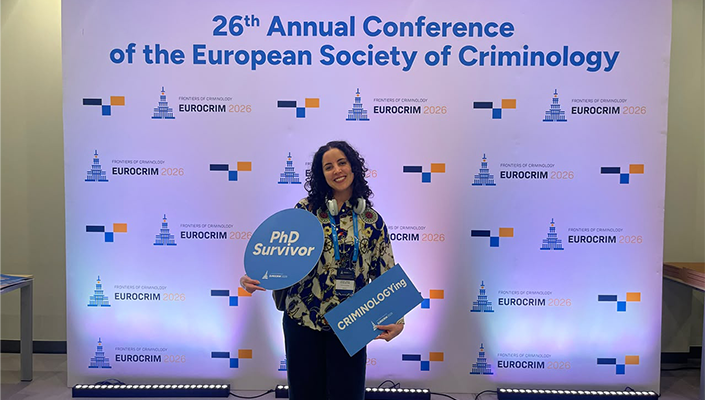
Larissa Leilane Fontes de Lima, a third-year PhD researcher at the Irish Centre for Human Rights, School of Law, University of Galway, presented findings from her comparative research on female imprisonment and the Bangkok Rules at two international academic conferences in September.
Larissa participated in EUROCRIM 2026, the 26th Annual Conference of the European Society of Criminology, held at the University of Warsaw, Poland, from 9 to 12 September. Under the theme “Frontiers of Criminology,” the conference brought together researchers and practitioners from different jurisdictions to discuss contemporary developments in criminology, criminal justice and penal policy.
As part of Prisons Working Group (PWG) Panel 13, “Comparative Prison Governance, Standards and State Capacity,” Larissa presented “Between Symbolic Compliance and Transformative Change: Female Imprisonment and the Internalisation of the Bangkok Rules in Brazil and Ireland.” Drawing on feminist criminology and critical approaches to human rights, the paper examined the extent to which the United Nations Rules for the Treatment of Women Prisoners and Non-custodial Measures for Women Offenders (the Bangkok Rules) have been translated into legislation, policies and institutional practices in Brazil and Ireland, as well as the limitations of those processes.
Later in September, Larissa participated online in Eklavya 2.0: International Ph.D. Colloquium, held on 24 and 25 September. The event was organised by the Office of the Dean for Research, Planning and Strategic Development at National Law University Delhi, in collaboration with the University of Galway and the University of Antwerp. It brought together doctoral researchers from different countries and disciplines to present their work to panels of academic experts and receive detailed feedback on their developing research.
As part of Panel C1, “Criminal Law: Women, Transgenders, and Children,” Larissa presented “Rethinking Female Imprisonment: A Critical Comparison of Brazil and Ireland Through the Lens of the Bangkok Rules.” The paper used the Bangkok Rules as an analytical lens rather than solely as a compliance checklist. It examined the capacity and limitations of international soft-law standards to contribute to substantive, intersectional and decarcerative change within two markedly different socioeconomic, cultural and institutional contexts.
Across both presentations, Larissa considered whether gender-sensitive reforms recognise women as autonomous rights-holders beyond their roles as mothers and caregivers, and whether improvements to custodial environments are accompanied by meaningful strategies to reduce reliance on imprisonment. The discussions provided valuable feedback and comparative perspectives from scholars working on critical criminology, gender, human rights and penal reform.
Larissa’s participation contributed to the international visibility of research undertaken at the University of Galway in these fields. Her involvement in the Eklavya 2.0 Colloquium also supported the University’s engagement in an international doctoral forum organised in collaboration with National Law University Delhi and the University of Antwerp, fostering academic exchange across different legal systems and geographical contexts.
Supervised by Dr Róisín Mulgrew, Larissa’s doctoral project aims to identify the conditions under which international standards on female imprisonment can move beyond formal recognition and influence penal practices and outcomes. The perspectives and feedback gathered at both conferences will inform the next stage of her ongoing PhD research.