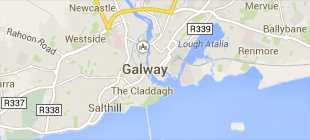
-
Courses
Courses
Choosing a course is one of the most important decisions you'll ever make! View our courses and see what our students and lecturers have to say about the courses you are interested in at the links below.
-
University Life
University Life
Each year more than 4,000 choose University of Galway as their University of choice. Find out what life at University of Galway is all about here.
-
About University of Galway
About University of Galway
Since 1845, University of Galway has been sharing the highest quality teaching and research with Ireland and the world. Find out what makes our University so special – from our distinguished history to the latest news and campus developments.
-
Colleges & Schools
Colleges & Schools
University of Galway has earned international recognition as a research-led university with a commitment to top quality teaching across a range of key areas of expertise.
-
Research & Innovation
Research & Innovation
University of Galway’s vibrant research community take on some of the most pressing challenges of our times.
-
Business & Industry
Guiding Breakthrough Research at University of Galway
We explore and facilitate commercial opportunities for the research community at University of Galway, as well as facilitating industry partnership.
-
Alumni & Friends
Alumni & Friends
There are 128,000 University of Galway alumni worldwide. Stay connected to your alumni community! Join our social networks and update your details online.
-
Community Engagement
Community Engagement
At University of Galway, we believe that the best learning takes place when you apply what you learn in a real world context. That's why many of our courses include work placements or community projects.
 Accessibility & Language
Running Up That Hill | Conference 2025
.png)
Running Up That Hill: Arts Funding and Economic Sustainability in the 21st Century
Wednesday 22 and Thursday 23 October 2025 | University of Galway
Sponsored by: Research Ireland Laureate Award ‘The Price of Performance’ (2023-2025) and the University of Galway, including the College of Arts, Social Science and Celtic Studies, the Institute for Creativity, School of English, Media and Creative Arts, Arts in Action, and Drama and Theatre Studies & Supported by the Town Hall Theatre Galway and Moonfish Theatre.
Artist Panels include: Dr Ali FitzGibbon (Belfast); Branar (Galway); Cathie Boyd (Glasgow); Catherine Wheels (Musselburgh); Dogstar (Inverness); Jane Daly (Arts Consultant and Facilitator); Kabosh (Belfast); Lian Bell (Dublin); Oceanallover (Dumfries and Galloway); Rough Magic (Dublin).
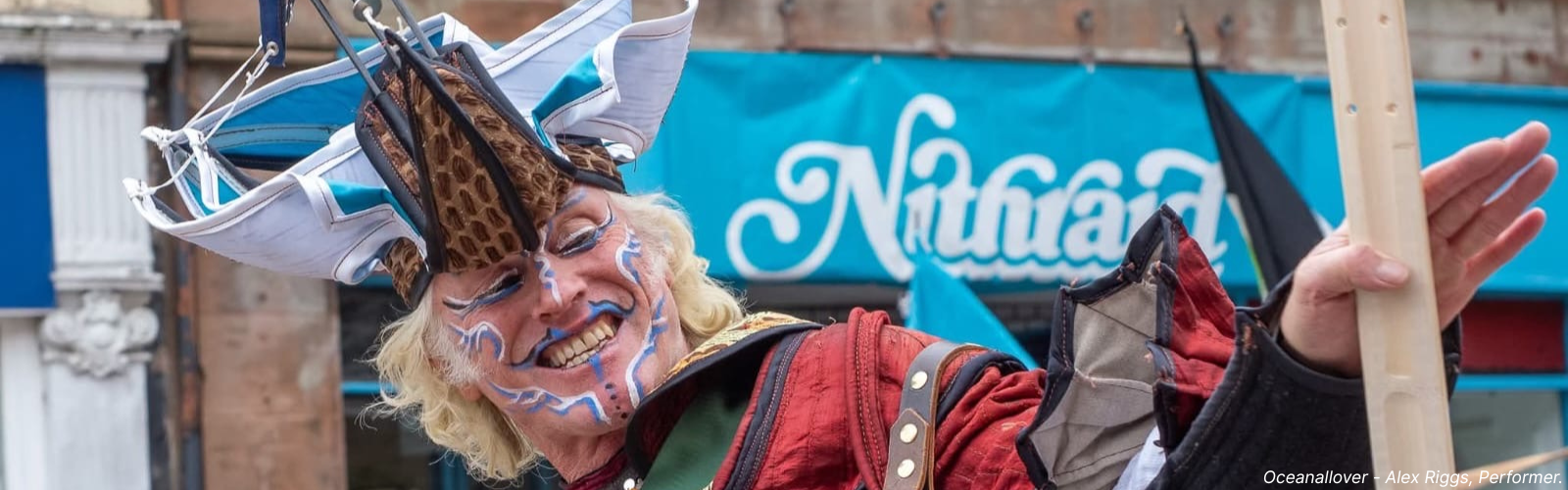
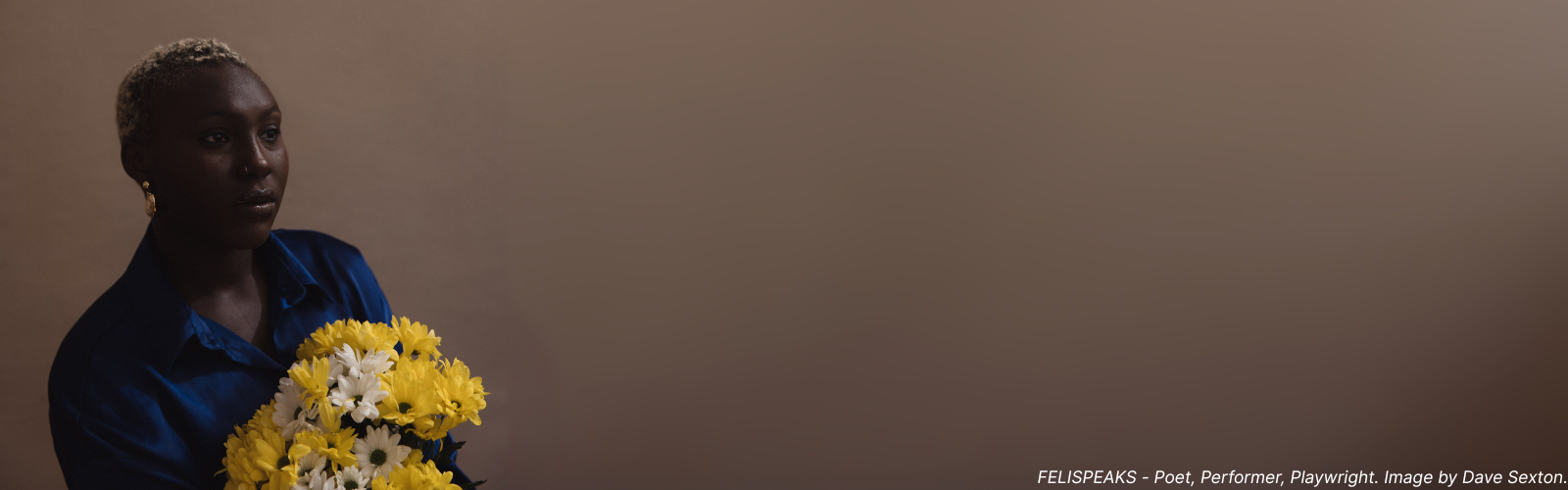
Performances By: Felispeaks; Oceanallover with Burren College of Art MFA Students and Dr Liam Carr (University of Galway/Pacesetters)
Keynote Speaker: Una Mullally, Irish Times
Roundtable: On Funding and Financial Sustainability with Jaine Lumsden, Theatre Officer, Creative Scotland; Toby Dennett, Strategic Development Manager, Arts Council Ireland; Ashleigh Lilley, Economist, Arts Council of Northern Ireland
In many European countries, arts and culture are deemed a ‘public good’¹ in government policy and thus recognized as valuable for society in both tangible and intangible ways. However, promises in policy do not necessary result in consensus regarding the value of a public good and its subsequent resource allocation. The fiscal fortunes of public goods are inherently intertwined with the general health of the public purse, subject to fluctuations in both political will and economic growth annually. The appetite to protect culture as a public good varies from country to country and government to government, though in recent years it has gained traction through global networks (UNESCO, ‘Culture as a Public Good’, Mondiacult 2022). However, more than a decade and a half on from the 2008 economic crash, for many artists working in post-austerity economies, a sense of recovery has not emerged despite strong economic growth nationally and the ensuing international momentum regarding policy commitments. If economic growth is reported as strong, and government policy recognizes and protects culture as a public good, then why is this not felt on the ground by artists working and living in these economies?
There is no universally agreed method of assessing arts and cultural value financially within public policy, and yet, for funding to be delivered so that arts and culture can be resourced, a financial value must be ascertained. As ‘The Price of Performance’ research project sponsored by Research Ireland (2023-2025) comes to a conclusion, this conference explores how financial resources are sourced by independent artists and organizations particularly on the island of Ireland and Scotland, how resource allocation occurs within public funding schemes, and what constitutes the evidence that underpins the rationale for resource allocation.
Access Conference Schedule here: Running Up That Hill Conference Schedule
¹‘Public good’ is defined by the UN Secretary-General Report ‘Our Common Agenda’ (2021) as resources that belong to humanity and cannot be adequately provided by individual states or non-state actors: https://www.un.org/en/content/common-agenda-report/
Conference Schedule
Running Up That Hill: Arts Funding and Economic Sustainability in the 21st Century | 22-23 October 2025
.png)
Speaker Biographies
Panel 1A: Balancing Public Funding with Artistic Intention
David Barnett - University of York
Squaring the Circle: How Arts Council-Funded Theatres in Yorkshire Balance Their Public Mission with Financial Sustainability Through Programming
The Arts Council of England (ACE) offers funding to many cultural institutions, including theatres. The support itself is relatively meagre in terms of overall running costs, yet the conditions set out by ACE are quite demanding. This paper seeks to understand how funded theatres’ repertoires navigate the demands placed on them by both ACE and the need to remain financially sustainable. This means that programming is, broadly speaking, torn between two directions: to satisfy a theatre’s cultural mission to engage its community in spectatorial activity that may enrich it; and to balance the books by scheduling events that have the potential to be commercially beneficial.
Drawing on unique access to extensive financial, audience and strategic data for the seasons of Sept 2021 to August 2023 and interviews with senior members of theatres’ management teams, the paper will offer perspectives on how four theatres in Yorkshire have tried to square this circle. Two of the theatres, the Lawrence Batley Theatre in Huddersfield and Cast in Doncaster, are receiving houses with limited financial abilities to stage their own shows. The other two, the Stephen Joseph Theatre in Scarborough and Hull Truck in Hull, both produce and receive theatre, offering a different set of factors to balance when considering their programming strategies. We will use qualitative and quantitative methods to analyse the choices the theatres have made in order to show not only how they have reconciled the two imperatives, but also to assess the success of their strategies.
Biography:
David Barnett is Professor of Theatre at the University of York. He is the author of monographs on theatricality (2024), Brecht’s theatre practices (2015), the Berliner Ensemble (2015) and Fassbinder’s theatre (2005), among others. He has published articles on structural differences between British and German theatre systems and the ways in which the British system struggles with producing experimental plays from abroad.
Charlotte McIvor - University of Galway
“I searched for my spark and I found it”(?):
Remixing Creativity, Sustainability and/or the Decolonial in post-Decade of Centenaries Irish Arts Policy
This paper examines the convergence of three revealing strands of arts policy and government agendas for the arts in the Republic of Ireland during and following the Decade of Centenaries (2017-2023). These include the formation of Creative Ireland (founded in 2017 and funded through 2025) as an “all-of-government culture and wellbeing programme” with an “ambition to inspire and transform people, places and communities through creativity,” a resurgence in arts-focused equality, diversity and inclusion initiatives and a concerted turn towards impact management (including monitoring and evaluation) which is crucial to understanding how the return on investment of the first two is being defended. Key documents and reports indicative of the Irish EDI and impact management turn include Arts Council’s 2021 Equality, Diversity and Inclusion toolkit, Safe to Create’s 2024 report Amplify: A Call Towards Transformative Action and the Arts Council’s 2022 Outcome Measurement Guidebook.
I begin with the energy and promised potential of this new inclusive Irish arts policy moment as most symbolically epitomized by the runaway viral success of the Irish children’s hip-hop groups Kabin Crew (Cork) and Lisdoonvarna Crew’s release of their single, “Spark,” funded by Creative Ireland. Released on 16 May 2024 for Cruinniú na nÓg (a national day of free creativity for children), the video for the song features a multi-racial and effervescent group of Irish children delivering a driving anthem that has amassed more than 7 million views on YouTube and more than 59 million plays on Spotify to date.
But whereas “The Spark’s” utopian performative moment captured all that is possible (or ideally postable on social media) when the participants/artists, aim of a project and public reach of a single event align perfectly with policy aims, this paper interrogates how the Republic of Ireland’s deployment of EDI and/or anti-racist rhetorics coupled with creativity discourse and impact measurement trends actually does or does not critically revise European and North American initiatives and histories where much of our most recent policy rhetoric around EDI as well as creativity and wellness originated. Drawing on the work of Claire Bishop (2012) and Eleanora Belfiore and Oliver Bennett (2008) on the UK and Shannon Steen on the US (2023) among others on impact, creativity, neoliberalism and government policy in the participatory arts and beyond, I explore whether our Irish remix of globalised arts policy trends productively builds on and potentially decolonises some of these origins or simply repurposes them threatening the ambition of these initiatives and the “spark” that their intentions and convergence might provide as we face also rising right-wing and particularly anti-immigrant /minority sentiment in Ireland today.
Biography:
Dr Charlotte McIvor is a Senior Lecturer/Associate Professor in Drama and Theatre Studies as well as one of the co-founders of Active* Consent, an Irish international research-led consent education programmed based at the University of Galway. In addition to her work appearing in multiple journals and edited collections, she is the author of Contemporary Irish Theatre: Histories and Theories (with Ian R. Walsh, 2024), Migration and Performance in Contemporary Ireland: Towards A New Interculturalism, and the co-editor of The Methuen Companion to Interculturalism and Performance (with Daphne P. Lei), Interculturalism and Performance Now: New Directions? (with Jason King), Devised Performance in Irish Theatre: Histories and Contemporary Practice (with Siobhán O’Gorman) and Staging Intercultural Ireland: Plays and Practitioner Perspectives (with Matthew Spangler). Her work has also appeared in Theatre Research International, Theatre Topics, Modern Drama, Irish University Review, Irish Studies Review, and multiple edited collections.
Máiréad Ní Chróinín
'The Price of Equity in Theatre-Making: A case-study from Moonfish Theatre.'
Dr. Máiréad Ní Chróinín (Moonfish Theatre/Drama, University of Galway)
“Who produces culture reflects social inequality … To ‘make it’ in a cultural job you need the sort of economic, social, and cultural resources that are not fairly shared within society” (Brook et al., Culture Is Bad For You).
This paper uses the case study of Moonfish Theatre’s production of ‘Why the Moon Travels’ as a jumping-off point to reflect on the hidden cost of building a more equitable theatre-making practice. It argues that, in order to ensure that more people from diverse backgrounds and experiences are supported to become and make work as artists, both company budgets and funder priorities need to account for the intersectional needs of the individual. As a first step, the paper offers for consideration a model that could allow artists, companies and funders to express and measure the cost of meeting these intersectional needs, with a view to tackling the inequality in ‘who produces culture’ in a structural and sustainable way.
Biography:
Máiréad Ní Chróinín is a theatre maker, lecturer and researcher, based in Galway, Ireland. She is co-director of the bilingual company Moonfish Theatre and also has an individual practice as a digital theatre maker. With Moonfish, Máiréad has created numerous theatre works for adults and young people, incorporating bilingualism, music, technology, movement, and puppetry.
Over the years the company has partnered with, amongst others, the Abbey Theatre, An Taibhdhearc (National Theatre of the Irish Language), Galway International Arts Festival, and Baboró International Arts Festival for Children.
The company’s most recent work, ‘Why the Moon Travels' (GIAF, 2025), based on the book by Oein DeBhairduin, draws on folktales from the Irish Traveller tradition, and was co-created with an ensemble of performers from the Traveller community.
In her individual practice Máiréad works with mobile and sensory technologies to create immersive audio performances that place the audience member in embodied communication with their environment. She has published on the creation and impact of these works, as well as on strategies for archiving digital audio performance.
Máiréad is Druid Lecturer at the Drama and Theatre Studies Department of University of Galway, where she lectures on devised and ensemble theatre, producing and arts management.
Panel 1B: Creative Objectives, Creative Policies
Maeve Freeney, Anna Sheldon, Aogán Smyth, Eavan Cronin, Fionnuala Brown
Lights Out in Galway: Valuing a Recently Closed Cinema in a UNESCO City of Film Abstract The recent closure of the Pálás cinema was unexpected to many, despite ongoing financial difficulties. Although the venue has closed, this does not imply an absence of its value to the wider community. However, capturing this value presents a significant challenge given traditional market-based approaches are not applicable. To address this, our study employs contingent valuation to assess the public’s willingness-to-pay for the hypothetical reopening of the Pálás cinema. A survey instrument was designed to collect this data, where respondents were asked a series of questions surrounding their personal characteristics, cinema habits, and willingness to pay for the re-opening of the Pálás. To estimate willingness-to-pay, two funding mechanisms were evaluated: higher ticket prices and an annual increase in general taxation. The results suggest strong support for the re-opening of the Pálás cinema, with our sample indicating a maximum willingness to pay of an additional €4.05 per cinema ticket and an increase of €22.25 in annual general taxation on average. These findings therefore present an economic case for the re-opening of the Pálás cinema and contribute to public debate advocating for greater investment in cultural assets within the Irish context.
Biographical Note:
This study was conducted by a group of MSc in Health Economics students (Anna Sheldon, Aogán Smyth, Eavan Cronin, Fionnuala Brown and Maeve Freaney) at the University of Galway, working under the guidance of their lecturer Brendan Kennelly. This study originally began as a group project for a course module in public sector economics; however, it gained unexpected attention, receiving 991 survey responses and even being featured on Galway Bay FM. Given this sample size, this project evolved beyond a standard assignment, allowing for the generation of robust and meaningful estimates to ascertain how much people truly value the Pálás cinema.
Mark Justin Rainey and Patrick Collins - University of Galway
Creative ecosystems in non-urban areas: cultural mapping as a basis for strategy and policy.
The Horizon Europe IN SITU project explores the innovation potential of the creative and cultural industries (CCIs) in non-urban areas of Europe. In 2023 the project carried out a cultural mapping exercise across six regions: the Azores, Portugal; West Region, Iceland; Galway, Ireland; Rauma and Eurajoki, Finland; Valmiera County, Latvia; and Šibenik-Knin County, Croatia. This included compiling an inventory of CCIs in each region and running a series of workshops with creative practitioners that considered the present and future of their region. In many cases this was the first time such locally specific data on CCIs had been gathered. What emerged was a picture of a multifaceted set of creative ecosystems in peripheral areas that spanned traditional and contemporary forms and practices. This presentation not only provides an overview of the findings, but also argues that we are witnessing a paradigm shift in how we view and imagine peripheral regions as sites of creativity and cultural production. The cultural mapping also serves as basis for the development of multi-level cultural strategies and policies to support non-urban CCIs and the presentation will offer some emerging recommendations from within the IN SITU project.
Biographies:
Mark Rainey is a human geographer at the University of Galway where he serves as a researcher on the Horizon Europe IN SITU project and is a founding member of UrbanLab Galway. Mark has experience in the cultural and refugee justice sectors in the UK and Australia. He has a PhD in Cultural Studies from the University of London and has published on the topics of political geography, cultural theory, ethnography and migration. Most recently he has taken up an interest in the geographies of local development. His upcoming book ‘Restless Justice: Asylum, Homelessness and Volunteering’ is due to be published with Manchester University Press.
Patrick Collins is an Economic Geographer and Associate Professor at the University of Galway. His research interests span broader global scales concerned with foreign direct investment patterns of the world’s largest technology companies to the contribution of culture and creativity to place based development in non-urban areas. Pat is co-director of the newly formed UrbanLab Galway, a publicly facing research centre at the University of Galway that seeks to activate the voices and desires of citizens in sketching the future of places. Author of over 30 internationally peer reviewed journals papers, Pat’s most recent book ‘Galway: Making a Capital of Culture’ was published by Orpen Press.
Osama Abu Shanab
The Environmental Cost of Creating Art
This case study explores the intersection of environmental accountability and artistic production within the context of the Galway International Arts Festival (GIAF), one of Ireland’s largest annual cultural events. In 2025, GIAF is undertaking its first full carbon audit with support from environmental consultants Climeaction. The goal is to measure greenhouse gas emissions to establish an emissions baseline that will inform the development of stronger environmental practices and support the integration of sustainability into the festival’s long-term planning.
What makes this initiative distinct is not only the scale and public visibility of the event, but also the strategic positioning of sustainability as both a creative driver and a financial imperative. In its effort to align with ISO 20121 Sustainable Event Management standards and commit to public emissions disclosure, GIAF is working to balance artistic freedom, stakeholder expectations, and environmental responsibility while planning to embed these principles more fully into its 2026 festival strategy.
The project explores the challenges of gathering reliable data, and the role of strategic partnerships in financing green transitions within the nonprofit arts sector. It also reflects on the environmental lifecycle of a major festival installation, Funeral for Ashes, to communicate the environmental cost of creating art and how it can be better balanced with artistic vision and resource use. Ultimately, financing sustainable cultural practice involves more than securing external support. It requires an ongoing commitment to building transparent data systems, encouraging lasting collaborative efforts, and embedding sustainability into every layer of festival planning. This work remains in progress, with efforts focused on capturing more comprehensive and accurate data across all major emission sources.
Biography:
Osama AbuShanab is a recent graduate of the MSc in Business Analytics at the University of Galway. Originally from Gaza, Palestine, he holds a background in Business Administration and Big Data Analysis. As part of the Galway International Arts Festival’s sustainability initiative, he worked closely with internal festival teams and environmental consultants from Climeaction. His contributions focused on supporting the carbon auditing process, engaging key stakeholders, and helping to shape a long-term sustainability strategy for the festival.
Panel 2: Commissioning and Funding New Plays
Paula McFetridge
Paula McFetridge has been Artistic Director of Kabosh since 2006. Kabosh is based in Belfast, in the north of Ireland. It is a theatre company committed to challenging the idea of what theatre is, who it is for and where it is staged. The work is staged in theatres and in found spaces. She commissions, dramaturgs and directs the company’s programme of original socially engaged practice. The work has toured locally, nationally and internationally. www.kabosh.net
Paula is a fellow of Salzburg Global Seminar Session 532 'Peacebuilding Through the Arts', was made Belfast Ambassador in recognition of utilising the arts to tackle difficult issues and won the Northern Ireland Tourism Board ‘Hero’ award for her work in cultural tourism. Prior to Kabosh she was Artistic Director of the Lyric Theatre 2000-2006 and Artistic Director of convictions with Tinderbox Theatre Company (‘Best Production’ 2000 Irish Times Awards).
Lynne Parker
Lynne Parker is the Artistic Director and co-founder of Rough Magic Theatre Company. Her most recent work for the company is Peter Hanly’s What Are You Afraid Of? with Kilkenny Arts Festival 2025 and Hilary Fannin’s Children of the Sun (after Gorky), Abbey Theatre 2024.
Other productions for Rough Magic: Freefalling by Georgina Miller, The Tempest (Kilkenny Arts Festival 2022), Solar Bones by Mike McCormack (KAF 2020, Best Director Award, Abbey 2022), Hecuba by Marina Carr (Dublin Theatre Festival 2019), A Midsummer Night’s Dream with KAF (Best Ensemble 2018), The House Keeper (Best New Play 2012), Don Carlos (Best Production 2007), The Taming of the Shrew (Best Production 2006), Improbable Frequency (Best Production, Best Director 2004), Copenhagen (Best Production 2002), Stewart Parker’s Pentecost (Best Irish Production, Dublin Theatre Festival 1995) and Declan Hughes’ Digging For Fire (London Time Out Award 1992), Love and A Bottle and Shiver.
Other work includes: Heavenly Bodies, The Sanctuary Lamp, Down The Line (Abbey); The Girl Who Forgot to Sing Badly (Theatre Lovett); also work for Charabanc, Druid, the Gate, the Bush, Corn Exchange, Almeida, Old Vic, West Yorkshire Playhouse, Birmingham Rep, Teatrul National Bucharest, Traverse Edinburgh, Lyric Belfast and the RSC.
She was awarded the Irish Times Special Tribute Award in 2008 and an Honorary Doctorate from Trinity College Dublin in 2010.
Matthew Zajac
Matthew Zajac studied drama at Bristol University. He has worked as an actor since 1982 and began producing and directing plays a few years later. He was a founder member of the Faultline Festival in 1986, the first alternative arts festival in the Highlands and jointly ran new writing company Plain Clothes Productions during the 1990s. He was also Associate Director of Caithness-based Grey Coast Theatre Company. He has been Artistic Director of Dogstar since 2004. He has worked as an actor at many theatres, including Citizens Theatre Glasgow, Manchester Royal Exchange, Liverpool Everyman & Playhouse, Bristol Old Vic, Edinburgh Lyceum, Bush, Young Vic. Matthew has appeared in numerous TV, film & radio dramas. In 2009, he was named Best Actor in the Critics’ Awards for Theatre in Scotland. His play The Tailor of Inverness, has played over 300 times around the world. His memoir of the same name was published in 2013, while Circling A Fox, a documentary about the play, was broadcast by the BBC. He has written two other plays, The Sky Is Safe (2017) and The Testament of Gideon Mack (2025).
Panel 3: The Economy of Producing Work for Children and Young Audiences
Joanne Beirne
Joanne is the executive producer with Branar Theatre Company. Having joined the company in October 2011, Joanne has worked closely with Branar's artistic director Marc Mac Lochlainn to develop the strategic direction of the company, building a national and international profile for the organisation. Prior to joining Branar, Joanne was the artistic director of the Belltable Arts Centre in Limerick, producing the Limerick Theatre Hub and was one of the founder members of the Strollers Touring Network during her tenure. Joanne has worked in various roles with Lane Productions, Corcadorca, Fishamble, Barnstorm and Galway Youth Theatre throughout her career. Joanne has an M.Phil in Irish Theatre Studies from Trinity College Dublin and a BA Hons in Drama & Theatre Studies from the University of Surrey.
Marianne Kennedy
Marianne is a Senior Lecturer of Drama and Theatre Studies in University of Galway, and theatre director and producer of 25 years. Her research interests include Irish language theatre and performance, the decolonisation of Irish theatre and Theatre for Young Audiences (TYA). Marianne is the Creative Director of The O' Donoghue Centre for Drama, Theatre and Performance, as well as AD of the University of Galway's ‘Arts in Action’ programme, producing lunchtime performances on campus, across circus, theatre, music, film, literature dance and VR. She is the founder of the Irish language theatre performance and research collective Giorria Theatre, and convenor of Ceangal | Cwlwm, a research and performance initiative between Scotland, Ireland and Wales bringing together those involved in theatre-making in Scottish Gaelic, Irish and Welsh in an annual symposium. Marianne has many directing credits including for Giorria Theatre Collective, Abbey Theatre, An Taibhdhearc and GIAF. Prior to entering the Academy she has served as CEO of Siamsa Tíre Theatre, the National Folk Theatre of Ireland, and also Director of An Taibhdhearc, the National Theatre of the Irish language and currently sits on the board of Galway Theatre Festival and Macnas.
Tony Reekie
I started working in children’s theatre in the early 90s, helping to set up and manage Visible Fictions Theatre Company. In 1995, I joined the Scottish International Children’s Festival as Festival Director and CEO. In 1998, the Festival became Imaginate, Scotland’s organisation supporting the development of the performing arts for children and young people. I worked with Imaginate for 20 years, then worked with several organisations, including The ASK (Art Space for Kids) in Shanghai, Hullabaloo in Darlington and Spark Arts for Kids in Leicester. I also programmed the Take Off Festival in Durham and co-programmed the Assitej Gathering in Kristiansand, Norway, both in 2019. Since 2019, I’ve been Executive Director of Catherine Wheels, Scotland’s leading theatre company for children and young people.
.png)
Panel 4: Managing Budgets During Economic Crisis
Lian Bell
Lian Bell is an artist working across artforms. With a background in scenography, visual art, cultural project management, and social activism, she has worked for over 25 years with some of the most significant arts organisations and contemporary performance makers in Ireland. She studied at Trinity College Dublin, Central Saint Martins, and NCAD, and has received numerous awards for her work.
She is interested in formally experimental performance, particularly in the hinterlands between visual art and theatre. She brings together groups of artists and arts workers to foster solidarity and community across geography and discipline. She advocates for mitching, slowing down, and travelling without flying, and designs ways to build community and create space for reflection.
Lian creates and facilitate artists’ programmes in collaboration with a number of different organisations, and also coaches people one-to-one. She was Campaign Director of #WakingTheFeminists, the grassroots campaign that changed Irish theatre.
Gemma Reeves
Gemma is Executive Director of Rough Magic and has been part of its senior management team since 2017. She has over 20 year’s experience in the Irish theatre industry; starting as an actor, she had leading roles with major companies including Rough Magic, Druid, the Abbey, the Gate and the Royal Court in London. In 2012, Gemma returned to education, receiving a first-class honours degree in Psychology from Dublin Business School. More recently, as an administrator and financial manager she has worked for the O’Reilly Theatre, and as a producer during the 2017 Dublin Fringe Festival at the Abbey’s Peacock Theatre. During her time at Rough Magic the company has staged major co-productions, national tours, filmed a theatre production for a nation-wide cinema release, produced a radio play, presented minifestivals and panel discussions, along with ten world premiere productions and a yearlong celebration for the company’s 40th anniversary in 2024.
Alex Rigg
Alex Rigg has been making live events since 1982, showing work internationally and to many kinds of people. He trained as an archaeological illustrator, drystone dyker, blacksmith, fine-artist, dancer, timber-framer, costume-maker and designer. His approach is off-beat and enigmatic, working with, for and alongside many leading creative artists and companies in Scotland. His dance-theatre company Oceanallover is a collaborative collective presenting imaginative work in unusual locations. His style borrows from many influences and genres, making reference to film, literature and popular culture. The subject matter of his work is often linked to global, ecological and philosophical concerns, encouraging the public to look harder at who and what they are.
Alex is based in South West Scotland and runs an off-grid studio making costume, sculpture and dance. He often works as mentor and facilitator offering residential retreats and an opportunity to work in the landscape.
Panel 5A: Precarity and Performance
Emer Lyons
Emer Lyons - PART(S)(W)HOLE: The personal is political is precarious.
ABSTRACT: What does it mean to be an Irish artist? Writer and performer Emer Lyons spent twelve years living in Aotearoa/New Zealand on various precarious visas which disqualified her from applying for any arts funding. She returned to Ireland in 2023 and since has received multiple residencies and funding opportunities. When away from Ireland, her bio always began with, Emer Lyons is an Irish writer. Is the life of an artist more sustainable when aligned with nationality? Her nationality was a point of note when away from Ireland, the significance of which has diminished since returning to live in Ireland. What does it mean to exist as an artist living in precarity outside of ‘home’? How does belonging suffer under precarious living conditions? Under what conditions can you call yourself an ‘Irish’ artist? In this performance, the artist will examine the conditions of existence as an artist both outside and inside of Ireland. Her performance, ‘PART(S)(W)HOLE’, will use combine performance, poetry, visuals and audio to illustrate the boundaries of precarity, reflecting on the socioeconomic conditions of what it means to belong. The title reflects the breaking up of relationships to people, place and language under conditions of impermanence. This performance is a reinterpretation of her 2025 Scene + Heard show.
Biography:
Emer Lyons is a writer and performer from West Cork living in Galway. She is a research assistant on the Active* Consent programme at the University of Galway. She has a PhD in lesbian poetry from the University of Otago. In 2025, her show PART(S)(W)HOLE was part of the Scene + Heard festival in Dublin, she was the Áras Éanna Artist in Residence on Inisheer and the recipient of a Creative Practitioner Bursary both in association with the Galway City Council. She is one of four poets in the anthology Beginnings Over and Over: Four New Poets from Ireland (Dedalus Press, 2025) edited by Leeanne Quinn. In 2024, she was a Play it Forward Fellow with Skein Press under the mentorship of Pascal O'Loughlin and received an Agility Award from the Arts Council Ireland. She is an awardee of one of the 2025 Irish Writers Centre Annaghmakerrig Residencies.
Nocht Studios
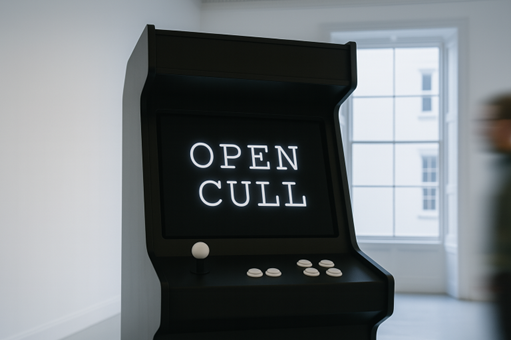
This presentation explores the systemic inequalities embedded in the open call as a commissioning format across the arts, architecture, and design sectors. While open calls are often framed as democratic entry points, they routinely shift risk and labour onto applicants, often demanding unpaid work, high levels of creative output, and emotional resilience, with no guarantee of compensation, feedback, or support. Open Cull critically interrogates these architectures of exclusion, asking how institutional processes extract value under the guise of fairness. Positioned within the thematic frame of Running Up That Hill, this short presentation, based on research for an interactive art installation currently in development, explores the uphill struggle faced by those navigating opaque selection systems, particularly emerging or experimental practitioners disproportionately affected by these demands.
As a creative response, Open Cull takes the form of a speculative design provocation, an interactive artwork inspired by the game Minesweeper. It gamifies the experience of navigating open calls: players encounter frequent rejection, occasional feedback, and rare moments of success. The work is not just satirical; it functions as a sensory and emotional map of a system that demands resilience while offering little in return. By transforming application fatigue into an embodied experience, the piece makes visible how structural inequity is felt, endured, and internalised.
Blending cultural critique, design strategy, and speculative formats, Open Cull proposes both a diagnosis and a provocation: what would it mean to design commissioning systems around equity, care, and transparency rather than scarcity and meritocracy?
The presentation invites discussion around establishing a set of ethical guidelines for open-call commissioning and exploring potential alternatives. It aims to build a collective call for a sector-wide review of commissioning practices, encouraging reflection on broader questions of institutional responsibility, the ethics of visibility, and the potential for cultural structures to be transformed from the ground up.
Nocht Studio Biographies:
Nocht Studio was founded by Martin McGloin and Philip Ryan in 2018 as a collaborative practice that operates at the intersection of design, visual culture, and spatial politics. Working across formats such as speculative design, installations, and research through making, Nocht interrogates the structures and systems shaping contemporary life, often focusing on the invisible forces embedded in both private and public institutions, infrastructure, and policy.
Drawing on architecture, public engagement, and critical theory, the studio’s work seeks to make tangible the intangible, whether through spatial interventions, data aesthetics, or participatory formats, often examining sites of manipulation, coercion, labour, and marginalisation.
Patricia O'Beirne
Valuing Art and Performance in a Neoliberal Policy Environment: Funding Structures of Independent Theatre Production in the Twenty-First Century
This paper problematises the pervading neoliberal political environment with respect to the arts and culture sectors in Ireland, the North of Ireland/Northern Ireland (NoI/NI) and Scotland, analysing the challenges inherent in achieving economic sustainability within a public policy framework which resists arts-led working methodologies as non-profit making entities.
Production budget analysis from six independent theatre companies provides foundational research for this paper, as part of ‘The Price of Performance’ (TPoP) project at the University of Galway, sponsored by the IRC Laureate scheme. This paper is informed by recent arts and cultural policies in Ireland, Scotland and NoI/NI, with production examples from 2000 to 2020 allowing for qualitative interrogation of the twenty-first century funding environment for theatre and performance practices. How are artistic expression and experience valued in an instrumentalist, metric-driven system within a UK context where austerity-led cut backs have devasted arts subsidies, or equally in an Irish context where austerity measures imposed funding cuts on the arts sector during a slow and painful recovery from the Celtic Tiger crash. Economic theory, cultural policy and theatre and performance research provide a framework for discussion in this paper as it questions what needs to change in order for economic sustainability to be achievable within the parameters of public funding schemes for theatre and performance.
Biography:
Patricia O’Beirne is a postdoctoral researcher working on ‘The Price of Performance (TPOP), an IRC Laureate 2023-2025 project with PI Dr Miriam Haughton in the University of Galway, which asks if and how economic sustainability arises for independent theatre production, despite the varying challenges the sector confronts. The project questions and analyses the economics of independent theatre production between 2000-2020 informed by the economic, geographic, artistic and socio-cultural conditions of Ireland, Northern Ireland and Scotland. Patricia’s publications include articles and chapters on theatre and economics; the Abbey Theatre Archive digitisation; on the Abbey Theatre Minute Books 1906 – 1939 and the history of the period, and on Irish theatre in the 1980s, particularly work staging Irish feminist, political and working-class theatre.
Panel 5B: Economic Sustainability and Arts Funding: Global Perspectives
Lia Capotorto
“That New York State of Money: Responding to a Performance Sector in Crisis”
Abstract:
This paper will consider how New York State responded to the COVID-19 pandemic and its impact on the performance sector. New York has long stood as an arts and cultural beacon in the US and worldwide that in 2020 became an epicenter for a raging, global pandemic. The impact of lockdowns and social distancing led to mass uncertainty and economic instability for artists, creative workers, and arts organizations in the live performance sector. To account for this severe impact on the industry, New York State’s public and private institutions took several steps to reignite performance safely. Examples included funding through government agencies, as well as additional opportunities such as NY PopsUp, and Creatives Rebuild New York to name a few. Changes in government tax policy and budgeting also led to significant impacts for both the nonprofit and commercial sector. This paper explores the numerous efforts made through public and private funding between 2020 and 2025 to assist in the recovery of organizations and individual artists in New York State. Public records, grantmaking data, as well as statements and reporting by artists and organizations provide the foundation for this research. The paper will also explore a transnational comparison of funding structures and recovery practices during this period between the US and Ireland. Analysis will draw upon my own embodiment of as an artist working in funding during
Biography:
Lia Capotorto is an experienced practitioner and arts administrator currently pursuing her PhD at University College Dublin (UCD). Her doctoral research explores contemporary performance and its relationship to joy. She holds an MA in Theatre Practice from UCD in partnership with the Gaiety School of Acting and a BA from Northeastern University. Her professional experience spans arts administration, strategic communications, and international higher education. Previously, Lia managed communications for the New York State Council on the Arts and their $100+ million grant making process. She currently tutors and occasionally lectures in drama and performance at the UCD School of English, Drama and Film. In addition to her research and teaching, Lia continues to create, produce, and consult on creative work.
Eirini Polydorou
Title: The Public Funding of Independent Theatre in Greece during 2003-2023. Does Greek theatre funding policy reflect the concept of culture as a public good?
Abstract
The proposed paper will explore the national-public funding for independent theatre in Greece during 2003-2023. The amounts allocated each year for theatre groups will be presented, as adjusted for inflation in real prices of 2023, after edition on data published by the Hellenic Statistical Authority. The data will be examined through the lens of a relevant policy analysis supported by a literature review on theatre policy of Greece in the 21st century. The analysis will explore the decisive factors explaining milestones of fluctuations in theatre public funding. Such factors are associated with both, circumstantial reactions and political decisions, where politics meet economics.
An example of the former was the rise of 1m euros in theatre funding in 2020, in response to the consequences of the lockdowns due to COVID-19 pandemic. An example of the latter was the decrease to zero funding for theatre in 2012, despite previous announcement of awarded allocations by the Ministry and theatre productions that were already ongoing. That happened in 2012, during the country’s financial crisis and supervision by the Troika – the International Monetary Fund (IMF), European Union (EU) and European Central Bank. The sudden disruption of any public funding for theatre challenged the independent theatre sustainability, which was already facing challenges linked with the sector’s precarious working conditions and lack of state safety nets.
The relevant policy analysis will include evolutions in the EU and international networks of important influence on the country’s policy directions, such as the concept of culture as a public good, especially promoted after UNESCO Mondiacult 2022. In this respect, expected findings of the paper will address the question whether the public funding for theatre has served the public good purpose of ensuring sustainability for independent theatre organisations, securing theatre from the powers of the market, in Greece of the 21st century.
Biography:
Eirini POLYDOROU is a PhD Candidate on Cultural Policy in the Department of Theatre Studies in the National and Kapodistrian University of Athens. She holds a BSc in Management Science and Technology from the Athens University on Economics and Business, a BSc in Theatre Studies from the University of Patras and a diploma in acting from Veaki Drama School. Her MA was in International and European Studies from the Panteion University of Social and Political Sciences. She also holds the European Diploma in Cultural Project Management from Fondation Marcel Hicter and has international work experience in cultural policy and in theatre performance, direction and production.
Finian O'Gorman
“The Best for the Most": How Arts Council Policy has Shaped Irish Theatre as an Industry and Artform”
Abstract:
Contemporary debates about arts funding in Ireland remain trapped in a zero-sum competition between professional and amateur spheres, with any proposal to support amateur theatre generating despair from an underfunded professional sector. This scarcity mindset, however, reflects artificial divisions between professional and amateur practice that were created by elite policy choices made over sixty years ago. This paper examines how pivotal decisions by the Arts Councils of Ireland, north and south, in the 1950s and 1960s fundamentally reshaped not just funding allocation but the very form and nature of Irish theatre itself.
When An Comhairle Ealaíon/The Arts Council of Ireland was established in 1951 and CEMA Northern Ireland evolved into the Arts Council of Northern Ireland in 1962, both organisations transitioned rapidly from supporting amateur grassroots theatrical development to exclusively privileging professional practice. This shift was most dramatic under Seán Ó Faoláin's directorship (1956-1959) of An Comharile Ealaíon, which withdrew support from an amateur movement that comprised 12,000 members. Drawing on archival evidence including Arts Council correspondence and annual reports, this paper demonstrates how the professional/amateur separation artificially constrained what had been productive overlaps between these spheres.
The paper shows that these transformative decisions rested on individual outlooks of figures like Ó Faoláin rather than emerging from democratic consensus, representing a fundamental failure of cultural democracy. By examining the contrasting fortunes of highly successful amateur festivals like Ballymoney against failed professional touring initiatives, it reveals how elite preferences for "democratization of culture" systematically excluded democratic input into policy formation. By recognizing that cultural policy decisions actively shape artistic forms, not merely funding levels, this historical analysis offers crucial perspective for contemporary debates about arts funding policies and outcomes.
Academic Bio
Dr Finian O’Gorman is a lecturer in Drama and Theatre Studies at the University of Galway. He is currently working on a book on the amateur theatre movement in Ireland, titled A History of Amateur Theatre in Ireland, 1930-1980: Staging Community and Nation. Dr O’Gorman was previously an Irish Research Council (IRC) Postdoctoral Fellow at the School of English, Trinity College Dublin (2023) and an IRC Postgraduate Scholar at the University of Galway. His published work has featured in Irish University Review (2024), Review of Irish Studies in Europe (2021), Irish Drama and Theatre Since 1950 (Bloomsbury, 2019), The Theatre of Enda Walsh (Carysfort, 2015), the Hungarian Journal of English and American Studies (2015), New Hibernia Review (2013), and Irish Theatre Magazine (2013). Dr O’Gorman is the Early Career Researcher (ECR) Support Officer for the Irish Society for Theatre Research (ISTR).
Arts Council Roundtable
Toby Dennett
Toby Dennett is Strategic Development Manager at the Arts Council working across areas of research and policy with a particular focus on the individual artist. He led the development the Arts Council’s Paying the Artist policy and co-chaired a recent EU OMC working group on the status and working conditions of artists and cultural and creative professionals in Europe. He originally joined the Arts Council in 2007 as Head of Artists’ Supports. He was previously the Director of Visual Artists Ireland the national resource body and representative for visual artists. Toby has also worked as a grant assessment officer in the Arts Council of Northern Ireland.
Ashleigh Lilley
Ashleigh Lilley is an Economist at the Arts Council of Northern Ireland, applying economic principles to demonstrate the impact of the arts. She recently led a study estimating the economic impact of the Art Council’s annual funding as well as the social valuation of selected outreach programmes. She works across other areas of research with particular interest in audience behaviour and equality issues. Ashleigh originally joined the Arts Council in 2012 as a Research & Policy Officer, leading in the field of equality. She was previously an Economic Consultant at Oxford Economics, where she led on socio-economic profiling, forecasting and economic impact assessments for UK-wide and European clients. Ashleigh also specialised in producing tourism forecasts for private sector clients and government departments in the Caribbean.
Jaine Lumsden
Jaine Lumsden works for Creative Scotland, the public body that supports the arts, screen and creative industries across Scotland. She is the specialist for circus, outdoor art, physical theatre and puppetry. Her other areas of work and expertise include projects to support the sustainability of independent producers, artist development, theatre and dance touring. She created and led the Scottish Project, Legacy Trust UK’s nations’ and region’s Cultural Olympiad programme for Scotland. She is a trained Liz Lerman Critical Response facilitator. Prior to working at Creative Scotland she was a freelance performance producer and production manager.
.png)
Conference Chair Biographies
Cathie Boyd
Cathie Boyd, an internationally respected stage director, producer and curator with 35+ years of experience, is known for her inspirational leadership and innovative approach across multiple art forms including opera, music, digital arts, and film. Raised in Belfast and a graduate of the Royal Conservatoire of Scotland, she founded Cryptic in 1994, aiming to stage groundbreaking music and sound-based performances that captivate global audiences. Cathie has been pivotal in showcasing artists worldwide, notably through establishing Glasgow's biennial Sonica Festival in 2012. Her work with new technologies has included developing live visuals for classical music with prestigious groups such as the Baltimore Symphony Orchestra and London Sinfonietta. Her accolades include an ISPA International Citation of Merit, a NESTA Fellowship, and the European Woman of Achievement for the Arts. Cathie has also held significant roles as President of the of IETM board and Vice Chair at Visiting Arts, London, and collaborated with Harvard University's metaLAB.
Jane Daly
Jane Daly is a Founding Co-Director of Irish Theatre Institute (2001-2021), a national resource organisation established to promote and support professional theatre makers and companies. In 2017, Jane shared the Special Tribute honour at the Irish Times Theatre Awards, with her colleague Siobhán Bourke, in recognition of their essential work with Irish Theatre Institute and long-standing commitment to Irish theatre.
Jane has worked in the professional arts sector since 1984 including roles at Dublin Theatre Festival and MayFest, Glasgow’s International Arts Festival before becoming General Manager/Producer of Druid where she produced over 30 shows, many of which toured both nationally and internationally. In 1996, she set up Jane Daly Arts Management which provides strategic planning, mentoring and facilitation services to arts organisations. She was acting Drama Officer at the Arts Council in the late 90’s and was Programme Manager for Galway’s successful bid for the European Capital of Culture designation in 2020. She is co-founder of Speak Up & Call it Out/Safe to Create, the government supported programme for Dignity in the arts and culture Workplace. She was a ministerial appointment to the Arts and Culture Covid Recovery Taskforce 2020 which delivered the Life Worth Living Report.
Ali FitzGibbon
Ali FitzGibbon is a Senior Lecturer in Creative & Cultural Industries Management in the School of Arts, English & Languages at Queen’s University Belfast. She researches decision-making, ethics, leadership and labour in contemporary cultural production and ecosystems, particularly freelancers, performing arts and festivals. She has published widely and is an editor of the Irish Journal of Arts Management & Cultural Policy. She was, for over 25 years, an international programme, producer and consultant with a particular focus on youth arts and performance for young audiences and large-scale collaborative youth and outdoor projects, working as lead producer for Replay Theatre Company (1997 – 2004), leading the Belfast Children’s Festival and Young at Art (2003 – 2016) and creating the original early years participatory dance event, Baby Rave. She is a co-founder of Fighting Words NI and has also worked as an advisor for a range of public bodies and government departments.
Brendan Kennelly
Brendan Kennelly studied economics at University College Cork and at the University of Maryland, College Park. He was a senior lecturer in economics at University of Galway until his retirement at the end of August in 2025. He was a Visiting Professor in the Department of Economics at Lehigh University in Pennsylvania from August 2002 to December 2003 and from January 2010 to August 2011. Brendan Kennelly has published articles on welfare economics, public choice, and health economics in journals such as Social Choice and Welfare, Public Choice, Social Science and Medicine, and Health Policy, and in several books.
Charlotte McIvor
Dr Charlotte McIvor is a Senior Lecturer/Associate Professor in Drama and Theatre Studies as well as one of the co-founders of Active* Consent, an Irish international research-led consent education programmed based at the University of Galway. In addition to her work appearing in multiple journals and edited collections, she is the author of Contemporary Irish Theatre: Histories and Theories (with Ian R. Walsh, 2024), Migration and Performance in Contemporary Ireland: Towards A New Interculturalism, and the co-editor of The Methuen Companion to Interculturalism and Performance (with Daphne P. Lei), Interculturalism and Performance Now: New Directions? (with Jason King), Devised Performance in Irish Theatre: Histories and Contemporary Practice (with Siobhán O’Gorman) and Staging Intercultural Ireland: Plays and Practitioner Perspectives (with Matthew Spangler). Her work has also appeared in Theatre Research International, Theatre Topics, Modern Drama, Irish University Review, Irish Studies Review, and multiple edited collections.
Rióna Ní Fhrighil
Professor Rióna Ní Fhrighil is Head of Discipline of Irish, Ollscoil na Gaillimhe-University of Galway. She is the Principal Investigator of the research project Republic of Conscience: Human Rights and Irish Poetry, funded by the Irish Research Council.
 |
Republic of Conscience is an IRC-funded research project that examines how Irish poets respond to international human rights violations and crises in their poetry.
roc.nuigalway.ie
|
Pól Ó Dochartaigh
A native of Belfast, Pól Ó Dochartaigh is Established Professor of European History at the University of Galway, having been Deputy President there 2014-24, and before that Professor of German and Dean of Arts at Ulster University. He holds BA degrees in German (Cardiff) and Irish (Ulster), and a PhD and DLitt in German and German History (Nottingham).
Pól is an elected Member of the Royal Irish Academy and a Fellow of the Royal Historical Society. He is a former President of the Association for German Studies in GB & IRL (2011-14). He has authored several books on German and German-Jewish history and literature, including Jews in GDR Prose Fiction (1997), Germany since 1945 (2003), Julius Pokorny, 1887-1970: Germans, Celts and Nationalism (2003) and Germans and Jews since the Holocaust (2015). He is currently working on the Scots presence in Connacht in the early twentieth century, and on Irish attitudes to Jews, 1920-70.
David O'Shaughnessy
David O’Shaughnessy is Professor of Eighteenth-Century Studies at the University of Galway. He has published widely on eighteenth-century theatre especially on William Godwin, Oliver Goldsmith, and Charles Macklin. He is currently the PI of a European Research Council-funded project ’The business of theatre, 1732-1809’ (2021-26) which seeks to understand the relationship between finance and cultural production in this period.
He is also a general editor of a new eight-volume Collected Works of Oliver Goldsmith for Cambridge University Press (2024- ). Recent publications include: Oliver Goldsmith in Context, with Michael Griffin (Cambridge University Press, 2024), The Censorship of Eighteenth-Century Theatre: Playhouses and Prohibition, 1737-1843 (Cambridge University Press, 2023), Charles Macklin and the Theatres of London, with Ian Newman, (Liverpool University Press, 2022), and Ireland, Enlightenment and the English Stage, 1740-1820 (Cambridge University Press, 2019).
Ian R. Walsh
Ian R. Walsh is Lecturer in Drama and Theatre Studies at University of Galway. He has published in peer-reviewed journals and edited collections. Books include Contemporary Irish Theatre: Histories and Theories (Palgrave, 2024) co-written with Charlotte McIvor and Experimental Irish Theatre: After W.B Yeats (Palgrave, 2012) and edited collections: Cultural Convergence: The Dublin Gate Theatre, 1928-1960 (Palgrave, 2021) and The Theatre of Enda Walsh (Peter Lang, 2019). From 2019-2022 Ian was PI for University of Galway on Circus ++ which developed the first international BA in Youth and Social Circus (Erasmus +). From 2019-2023 he was the PI for Wires Crossed: Head, Heart Balance (Creative Europe). In 2024 he co-authored the Circus Trans Formation Advanced Research Report (Erasmus +). He was Chair of Galway Community Circus from 2022-2024 and is still a current board member.
.png)
Visiting Galway - Travel and Accommodation Advice
Travel Advice for International Delegates
Dublin Airport – there is a direct coach service from Dublin Airport to Galway. It takes 2.5 to 3 hours, and coaches are fully air-conditioned. Pre-booking in advance is advised – www.citylink.ie/
Dublin City Centre – Citylink coaches also go from Dublin city centre; advanced booking is strongly recommended. You can also travel from Dublin city to Galway by train. Trains often book out in advance so you should book a seat and arrive in plenty of time if you are travelling this way - www.irishrail.ie
Dublin Port – if you are arriving by ferry, you should catch a Luas (tram) or Bus to the city centre from the Dublin portal terminal and from there should use either the Citylink or Irish Rail service to Galway.
Shannon Airport – is roughly an hour’s drive to Galway. There is a regular bus service, run by Bus Eireann, on the route from Cork to Galway https://www.shannonairport.ie/bus
Ireland West/Knock Airport – roughly a 90 minute drive from Galway. There is a bus service to Galway as part of the Bus Eireann route from Galway to Derry https://www.buseireann.ie/routes-and-timetables/64
Driving - we recommend that delegates avoid driving to Galway due to heavy traffic congestion and limited parking. However, if you do have to drive to the University of Galway campus, there are limited “pay and display” spaces available on-campus, some of which are directly adjacent to the conference venue. There is also limited street parking near the university, and again this must be paid for. Please be aware that your car will be clamped if you do not park in a designated visitor space and/or do not pay a parking fee (this is not something that we as organisers have any control over).
Accommodation Recommendations+ (distance from University of Galway)
Hotels:
https://www.leonardo-hotels.com/galway/leonardo-hotel-galway – Quay St, Latin Quarter (1.1km walking)
https://www.thehousehotel.ie/ – Spanish Parade, Latin Quarter (1.2km walking)
https://www.harbour.ie/en/ – The Docks (1.2km walking)
https://www.thehardiman.ie/ – Eyre Square (1.1km walking)
https://www.thegalmont.com/en/ – Lough Atalia Rd (1.5km walking)
https://www.salthillhotel.com/ – The Promenade, Salthill (3.8km by car or walking)
https://www.galwaybayhotel.net/ – The Promenade, Salthill (3.8km by car or walking)
https://www.theardilaunhotel.ie/ – Taylors Hill, (2.6km by car or 2.1km walking)
https://www.hydehotel.ie/ - Eyre Square (1.1km walking)
Hostels:
https://www.kinlaygalway.ie/ Eyre Square (1.1km walking)
https://galwaycityhostel.com/ Eyre Square (1.1km walking)
B & B Accommodation:
https://ardawnhouse.com/ - Ardawn House, College Road. (1.8km walking)
https://cappaveagh.com/ - Cappa Veagh B&B, Dalysfort Road, Salthill. (2.3km walking)