-
Courses

Courses
Choosing a course is one of the most important decisions you'll ever make! View our courses and see what our students and lecturers have to say about the courses you are interested in at the links below.
-
University Life
University Life
Each year more than 4,000 choose University of Galway as their University of choice. Find out what life at University of Galway is all about here.
-
About University of Galway
About University of Galway
Since 1845, University of Galway has been sharing the highest quality teaching and research with Ireland and the world. Find out what makes our University so special – from our distinguished history to the latest news and campus developments.
-
Colleges & Schools
Colleges & Schools
University of Galway has earned international recognition as a research-led university with a commitment to top quality teaching across a range of key areas of expertise.
-
Research & Innovation

Research & Innovation
University of Galway’s vibrant research community take on some of the most pressing challenges of our times.
-
Business & Industry
Guiding Breakthrough Research at University of Galway
We explore and facilitate commercial opportunities for the research community at University of Galway, as well as facilitating industry partnership.
-
Alumni & Friends

Alumni & Friends
There are 128,000 University of Galway alumni worldwide. Stay connected to your alumni community! Join our social networks and update your details online.
-
Community Engagement
Community Engagement
At University of Galway, we believe that the best learning takes place when you apply what you learn in a real world context. That's why many of our courses include work placements or community projects.
 Accessibility & Language
The Challenge
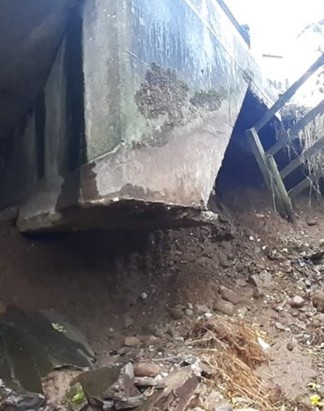
Ireland’s bridge infrastructure is facing increasing pressure from climate change, particularly through more frequent and intense rainfall events that elevate the risk of bridge scour, which is one of the leading causes of bridge failure worldwide. The picture below shows scour on a bridge pier.
At the same time, managing bridge risk across Ireland is highly complex due to the fragmented nature of asset ownership and data systems.
A Fragmented National Bridge Network
Norther Ireland's road and rail network includes an estimated 26,000 bridges and is managed by the Department of Infrastructure (DFI). The Republic of Ireland’s road and rail network includes an estimated 40,000 bridges, managed by multiple organisations:
- Department of Transport: Overall responsibility for the national road network
- Transport Infrastructure Ireland (TII): Manages the strategic and national road network
- Around 2,000–3,000 bridges
- Supported by the Eirspan system, providing high-quality inspection and condition data
- Road Management Office (RMO): Oversees MapRoad and the Bridges App, intended to serve as a national inventory of regional and local bridges
- Local Authorities (32–33 councils): Responsible for the majority of regional and local road bridges
- Varying levels of data availability and digital adoption
- Many bridges not yet fully integrated into national systems
- Iarnród Éireann (Irish Rail): Manages ~400 railway bridges, typically supported by detailed and well-maintained inspection datasets
Data Gaps and Limitations
Despite the existence of national systems:
- Only ~18,000 bridges are currently recorded in the Bridges App
- Of these, only ~5,000 bridges have up-to-date inspection data
- There is limited or no detailed information for a large proportion of the remaining bridges
- Many structures—particularly at local level—lack consistent inventory, condition, or risk data
This results in:
- Limited visibility of national bridge risk
- Difficulty prioritising maintenance and intervention
- Inefficient allocation of resources
The Scour Risk Challenge
Bridge scour risk is particularly difficult to manage because it:
- Requires hydrological, structural, and geotechnical data
- Is often location-specific and event-driven
- Is sensitive to climate change impacts (e.g. extreme flooding)
Given the scale of the network and gaps in data, traditional assessment methods are not scalable nationwide.