-
Courses

Courses
Choosing a course is one of the most important decisions you'll ever make! View our courses and see what our students and lecturers have to say about the courses you are interested in at the links below.
-
University Life

University Life
Each year more than 4,000 choose University of Galway as their University of choice. Find out what life at University of Galway is all about here.
-
About University of Galway

About University of Galway
Since 1845, University of Galway has been sharing the highest quality teaching and research with Ireland and the world. Find out what makes our University so special – from our distinguished history to the latest news and campus developments.
-
Colleges & Schools

Colleges & Schools
University of Galway has earned international recognition as a research-led university with a commitment to top quality teaching across a range of key areas of expertise.
-
Research & Innovation

Research & Innovation
University of Galway’s vibrant research community take on some of the most pressing challenges of our times.
-
Business & Industry
Guiding Breakthrough Research at University of Galway
We explore and facilitate commercial opportunities for the research community at University of Galway, as well as facilitating industry partnership.
-
Alumni & Friends

Alumni & Friends
There are 128,000 University of Galway alumni worldwide. Stay connected to your alumni community! Join our social networks and update your details online.
-
Community Engagement
Community Engagement
At University of Galway, we believe that the best learning takes place when you apply what you learn in a real world context. That's why many of our courses include work placements or community projects.
 Accessibility & Language
Pharmacology for Undergraduates
Pharmacology
Pharmacology is the scientific study of how drugs affect living systems. The word is derived from the Greek “pharmakos” meaning “medicine” or “drug”, and “logos” meaning “study of”. Pharmacology explores how drugs interact with biological systems at the molecular, cellular, tissue, and whole-organism levels to produce their effects. These effects may be beneficial, such as in the treatment of disease; or harmful, resulting in adverse reactions or even toxicity.
Pharmacology at Undergraduate Level
At University of Galway, Pharmacology is core component of many different undergraduate programmes, including in undergraduate Medicine, Pharmacy and Nursing. All of these professional healthcare programmes require their graduates to have a sound knowledge of the uses, benefits and potential harms of drugs, for effective and safe use in the healthcare system.
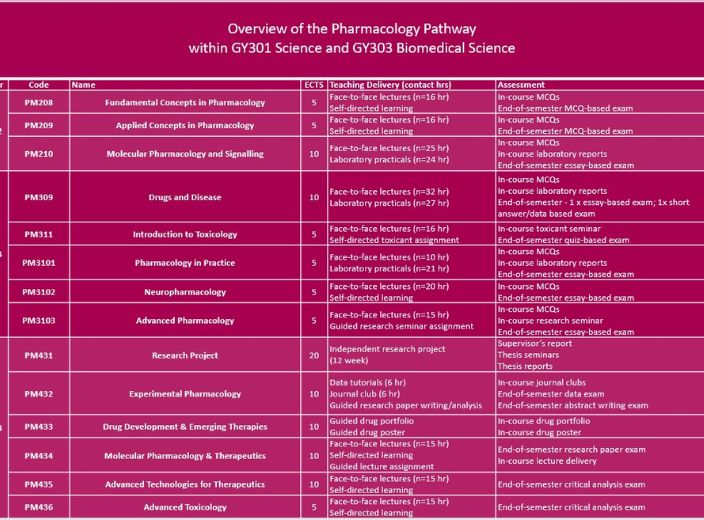
However, the main way to study Pharmacology as a topic of scientific study in its own right, is by taking it as a subject through the Bachelor of Science and Bachelor of Science (Biomedical Science) programmes. In both of these undergraduate programmes, students take a broad base of science subjects in the first year and then begin to specialise in the second year by selecting specialised subjects. Pharmacology is one such subject that BSc students begin to study in their second year, with many going on to specialise in Pharmacology as their main subject in final year.
Pharmacology Graduate Attributes
Pharmacology graduates develop a strong foundation in the scientific principles underlying drug action, combined with practical laboratory expertise and a wide range of transferable skills. These include experimental design, data analysis, problem-solving, and the ability to think critically and evaluate scientific evidence. Their training spans the study of drugs and their interactions with biological systems at molecular, cellular, and physiological levels, as well as an understanding of safety, efficacy, and toxicity.
In addition to technical competence, graduates gain valuable communication, teamwork, and research skills, enabling them to work effectively in multidisciplinary environments. This broad and adaptable skill set prepares them for diverse career pathways, including roles in biomedical and clinical research, pharmaceutical and biotechnology industries, drug discovery and development, regulatory affairs, science communication, and other health-related fields.
Key Links
For more information on undergraduate pharmacology, please see: