-
Courses
Courses
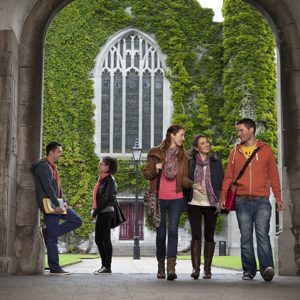
Choosing a course is one of the most important decisions you'll ever make! View our courses and see what our students and lecturers have to say about the courses you are interested in at the links below.
-
University Life

University Life
Each year more than 4,000 choose University of Galway as their University of choice. Find out what life at University of Galway is all about here.
-
About University of Galway

About University of Galway
Since 1845, University of Galway has been sharing the highest quality teaching and research with Ireland and the world. Find out what makes our University so special – from our distinguished history to the latest news and campus developments.
-
Colleges & Schools
Colleges & Schools
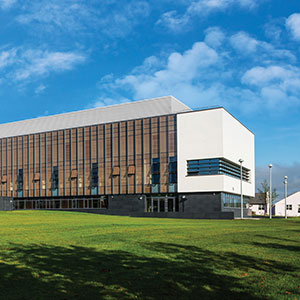
University of Galway has earned international recognition as a research-led university with a commitment to top quality teaching across a range of key areas of expertise.
-
Research & Innovation

Research & Innovation
University of Galway’s vibrant research community take on some of the most pressing challenges of our times.
-
Business & Industry
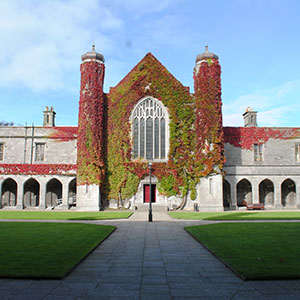
Guiding Breakthrough Research at University of Galway
We explore and facilitate commercial opportunities for the research community at University of Galway, as well as facilitating industry partnership.
-
Alumni & Friends
Alumni & Friends
There are 128,000 University of Galway alumni worldwide. Stay connected to your alumni community! Join our social networks and update your details online.
-
Community Engagement
Community Engagement
At University of Galway, we believe that the best learning takes place when you apply what you learn in a real world context. That's why many of our courses include work placements or community projects.
 Accessibility & Language
GENPATH

GENPATH
Our Aim
The GENPATH project aims to analyse gender differences in the construction and consequences of exclusion from social relations across European countries, and its consequences for health and wellbeing. Findings will be used to inform the scientific debate about social exclusion, and to inform policies to reduce exclusion from social relations in older men and women. GENPATH fits the SDG 3: Ensure healthy lives and promote well-being for all at all ages.
Rationale
Social exclusion in later life is a multifaceted social problem with substantial disruptive consequences for individuals and society. One aspect of social exclusion is the exclusion from social relations, which is the key focus of this project. Being socially connected is a universal basic human need; key to the development of infants, and important throughout the life course. However, a substantial proportion of older adults are socially excluded and lack the essential social connection necessary for a healthy and happy life. Social exclusion may have its roots in early life, but patterns of social exclusion over the life course may well be different for men and women.
Women generally have lower education, more often disrupted labour force participation, lower pensions, and are more often widowed because of longer life expectancy. Whether and how precisely this leads to higher rates of exclusion for women is still largely unknown. Scientific knowledge of the gendered pattern of exclusion from social relations is scattered and policies to reduce the inequalities limited in effectiveness.
Objectives
- What is the prevalence of exclusion from social relations and its risk factors in later life in Europe and how does this vary across societies as well as between older men and women?
- What are outcomes of exclusions from social relations in later life in Europe and how does these vary across societies as well as between older men and women?
- Do variations in micro-, meso-, and macro-level drivers for exclusion, including the gendered social norms, key life transitions and exclusionary processes, help to explain cross-national and gender differences in the prevalence of exclusion from social relations?
- Do micro-, meso-, and macro-level factors, including the gendered social norms, key life transitions and exclusionary processes, have a moderating or mediating impact on outcomes of exclusion from social relations, and do differences in the prevalence of these factors explain cross-national and gender differences in outcomes from exclusion from social relations?
- How to design policies and interventions to address the sources and alleviate the negative outcomes of the exclusion from social relations in men and women during their life course? How, if at all, should these policies and interventions be fitted to welfare regimes of various nation states?
Partners & Collaborators
- Lucie Vidovićová (Czechia)
- Marcela Petrová Kafková (Czechia)
- Petr Fučík (Czechia)
- Jan Lorman (Czechia)
- Marja Aartsen (Norway)
- Thomas Hansen (Norway)
- Feliciano Villar Posada (Spain)
- Montserrat Celdrán (Spain)
- Rodrigo Serrat (Spain)
- Andreas Motel-Klingebiel (Sweden)
- Susanne Kelfve (Sweden)
- George Pavlidis (Sweden)
- Axel Ågren (Sweden)
- Franz Kolland (Austria)
- Anna Wanka (Austria)
- Ariela Lowenstein (Israel)
- Ruth Katz (Israel)
- Sigal Naim (Israel)
Outputs
Policy Briefs
ICSG, (2023), Exclusion from Social Relations for Older Men and Women, Irish Centre for Social Gerontology, Policy Brief, University of Galway, Ireland
Model Lessons
Introduction - Information for Teachers
Aloneness and Loneliness at Various Stages of Life
What Is Aloneness and Loneliness and How Can We Actively Listen to Others