-
Courses

Courses
Choosing a course is one of the most important decisions you'll ever make! View our courses and see what our students and lecturers have to say about the courses you are interested in at the links below.
-
University Life
University Life
Each year more than 4,000 choose University of Galway as their University of choice. Find out what life at University of Galway is all about here.
-
About University of Galway

About University of Galway
Since 1845, University of Galway has been sharing the highest quality teaching and research with Ireland and the world. Find out what makes our University so special – from our distinguished history to the latest news and campus developments.
-
Colleges & Schools
Colleges & Schools
University of Galway has earned international recognition as a research-led university with a commitment to top quality teaching across a range of key areas of expertise.
-
Research & Innovation

Research & Innovation
University of Galway’s vibrant research community take on some of the most pressing challenges of our times.
-
Business & Industry
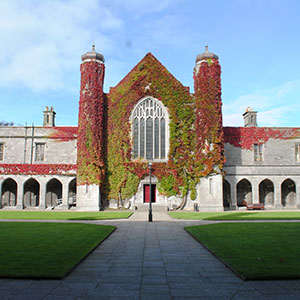
Guiding Breakthrough Research at University of Galway
We explore and facilitate commercial opportunities for the research community at University of Galway, as well as facilitating industry partnership.
-
Alumni & Friends
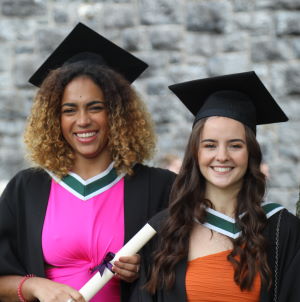
Alumni & Friends
There are 128,000 University of Galway alumni worldwide. Stay connected to your alumni community! Join our social networks and update your details online.
-
Community Engagement
Community Engagement
At University of Galway, we believe that the best learning takes place when you apply what you learn in a real world context. That's why many of our courses include work placements or community projects.
 Accessibility & Language
Online School on Human Rights
Online School on Human Rights 2026
Rights in Europe: The Risks and Impact of Authoritarianism
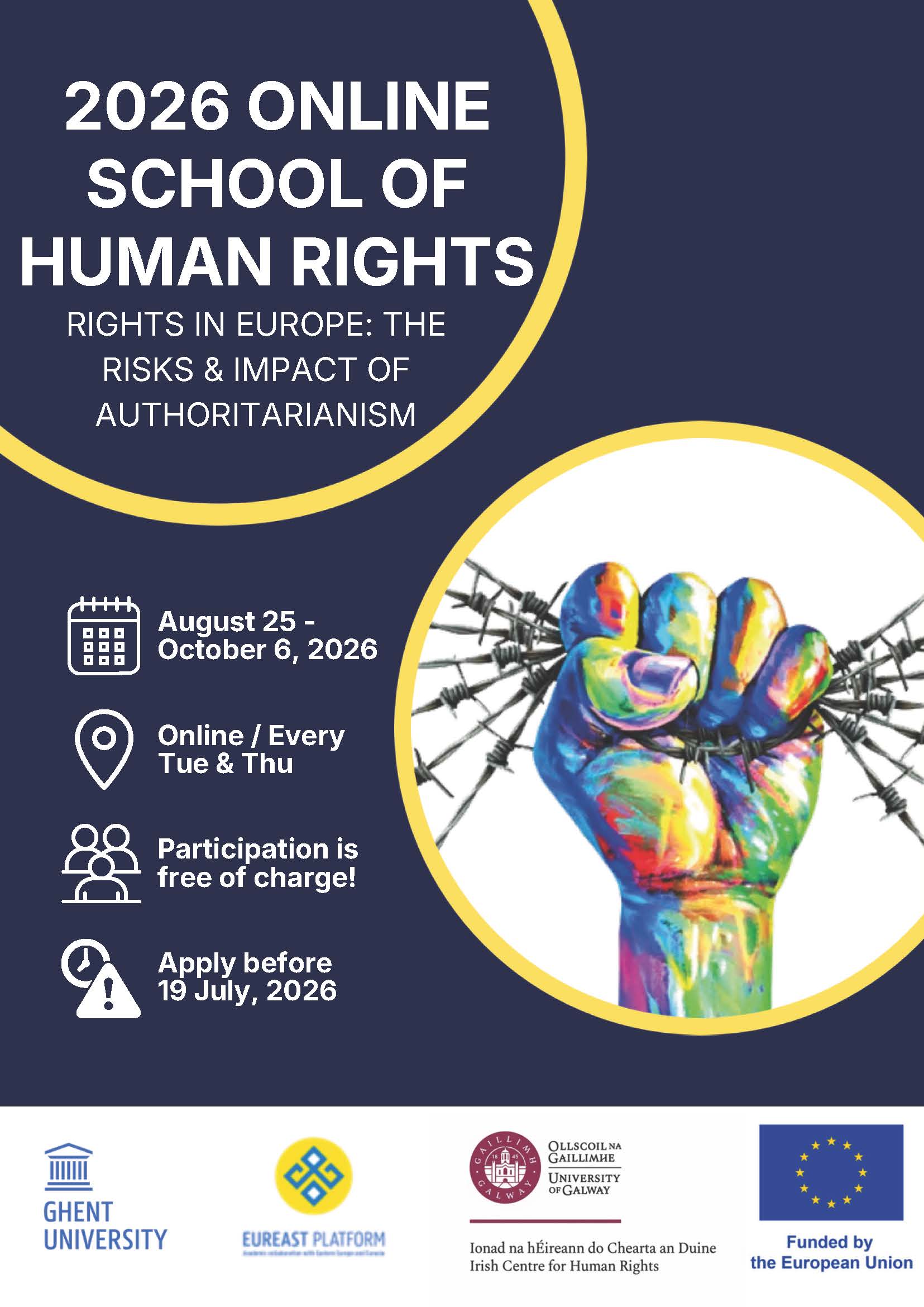
The call for application for the Online School on Human Rights is now open! The third edition of the School will explore fundamental rights in the wider region of Europe shedding light on how institutions and political regimes shape the enjoyment of human rights amidst authoritarianism and global normative contestation. The School will critically engage with how institutions and political systems affect human rights protection, explore core societal transformations in digital and environmental policies, and analyze the instrumentalization of human rights language. The program will also address human rights during armed conflicts, particularly relevant given the current global increase in warfare.
The objective of the School is to equip participants with skills to understand human rights within different legal, political, and social contexts, critically analyse discursive narratives surrounding human rights, develop effective advocacy strategies, and conduct interdisciplinary human rights research.
The School is organised by ENLIGHT+ partners: Ghent University's Eureast Platform, The Irish Centre for Human Rights, University of Galway in partnership with University of Groningen, Uppsala University and UGent Human Rights Research Network. The School is funded by the European Union project The Eastern Partnership Civil Society Facility.
Program Format
The 6-week program between 25 August – 6 October, 2026, and includes 30 academic hours (equivalent to 3 ECTS credits, subject to recognition by the students' home universities) delivered entirely online in English, with interactive lectures twice weekly (Tuesdays and Thursdays at 18:00 CET), a methodological workshop, collaborative group projects, and networking opportunities with students from across Europe, the Caucasus, Belarus, Ukraine, Moldova, Central Asia and the wider world.
Programme
The School is structured into four thematic blocks, a methodological workshop, and a final project presentation.
Block 1: The mechanisms of human rights and its interaction with institutions
- Lecture 1: Human rights and democratic backsliding: comparative constitutionalism approach
- Lecture 2: The Implementation Gap: Challenges in Realising Human Rights
- Lecture 3: Human Rights as peer review: international institutions and other accountability mechanisms
Block 2: New frontiers of human rights in a contested context
- Lecture 4: Digital rights in the era of post-truth
- Lecture 5: Women’s and LGBTQI+ rights versus ‘traditional values’?
Contemporary global struggles around gender and sexuality
- Lecture 6: Human Rights Aspects of International Migration Flows to Europe
Block 3: Human Rights appropriation and early-warning system
- Lecture 7: How to Anticipate Authoritarian Backsliding? Emergency Governance and Human Rights Implications
- Lecture 8: Critical approaches to human rights: appropriation and abuse of human rights by authoritarian regimes (discursive approach)
Block 4: From theory to practice: human rights advocacy and citizens’ engagement
- Lecture 9: Grassroots politics and the ghosts of the Soviet past: a view of the artist on human rights in the post-Soviet space
- Lecture 10: Human rights advocacy: citizens participation in human rights promotion and accountability
Methodological & Practical Components:
- Methodological workshop on interdisciplinary research on human rights: Equipping students with methods for analysis, documentation, and monitoring.
- Group Project: During the course, participants will work in small groups to research and prepare a project on a topic covered during the School, presenting their findings at the closing ceremony.
The full list of speakers from our partner universities will be confirmed soon.
Certificate
Upon the completion of the lectures and implementation of the group project, the participants will be given the certificates issued by all partner universities. The School workload is equivalent to 3 ECTS (upon the recognition of students’ home universities). To qualify for the certificate, participants must attend and actively engage in 10 lectures and complete the group project.
Eligibility
The School welcomes final-year undergraduate and graduate students from Europe, the Caucasus, Belarus, Ukraine, Moldova, Central Asia and other countries who are interested in critically examining human rights challenges in contemporary political contexts.
To apply for the School, please submit an application via the registration form. All applicants must submit their CV (max. 2 pages) and a motivation letter (max. 1 page) explaining their motivation to take part in the School and their background in human rights.
Participation in the Online School on Human Rights 2026 is free of charge.
Application deadline is 19 July 2026.
Apply Now! Application form via https://forms.gle/LRXUkwxGetpp2NP49
For more information, please contact:
iana.ovsiannikova@ugent.be and a.morley6@universityofgalway.ie