-
Courses

Courses
Choosing a course is one of the most important decisions you'll ever make! View our courses and see what our students and lecturers have to say about the courses you are interested in at the links below.
-
University Life

University Life
Each year more than 4,000 choose University of Galway as their University of choice. Find out what life at University of Galway is all about here.
-
About University of Galway

About University of Galway
Since 1845, University of Galway has been sharing the highest quality teaching and research with Ireland and the world. Find out what makes our University so special – from our distinguished history to the latest news and campus developments.
-
Colleges & Schools

Colleges & Schools
University of Galway has earned international recognition as a research-led university with a commitment to top quality teaching across a range of key areas of expertise.
-
Research & Innovation

Research & Innovation
University of Galway’s vibrant research community take on some of the most pressing challenges of our times.
-
Business & Industry
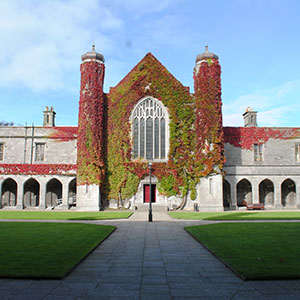
Guiding Breakthrough Research at University of Galway
We explore and facilitate commercial opportunities for the research community at University of Galway, as well as facilitating industry partnership.
-
Alumni & Friends

Alumni & Friends
There are 128,000 University of Galway alumni worldwide. Stay connected to your alumni community! Join our social networks and update your details online.
-
Community Engagement
Community Engagement
At University of Galway, we believe that the best learning takes place when you apply what you learn in a real world context. That's why many of our courses include work placements or community projects.
 Accessibility & Language
First Year
Welcome to Philosophy
Welcome to all our incoming Philosophy students! We are delighted you have chosen to study Philosophy and look forward to introducing you to the fascinating world of philosophical thought. In first year, you will be brought on a whistle stop tour of the main figures in the history of Philosophy exploring those ideas which formed the world as we know it. Your skills in reasoning and articulating ideas will be stimulated and developed. Practical issues of morality will be discussed in all their complexity and the therapeutic capacity of philosophy as well as its potential for understanding such ubiquitous themes as love and the nature of the self will be discussed. While classes can be big, you will be placed in tutorial groups of 15 students, which meet weekly to discuss the lecture topics.
Please make sure you are familiar with the following:
- Raising a query on teaching issues: Student queries - recommended stages
- Answers to queries re. online learning (Canvas) available here.
Contact:
Head of Year: Dr. Orla Richardson orla.richardson@universityofgalway.ie
Handbook
Handbook 1st Arts Philosophy Academic Year 26_27 (updated 17th Sept).pdf
Students Support - Support Wheel
We want you to feel part of our university community, learn lots and truly enjoy your time here. We also acknowledge that student life comes with its own unique challenges that at times can be difficult and you may need help to respond to some of the challenges you will face. There are many supports in the university that you can access when you need them. We are here for you!
The Support Wheel is an easy way to see what support is available to you, based on your needs and how you're feeling. It gives us a chance to meet you where or how you are - and help you get to where you want to be.
Timetables
1st Arts Semester One 2026/27
Lectures:
Students must attend all the lectures for all of their modules and should, where advised by their lecturer, complete the reading in advance. Students are responsible for taking their own notes during lectures and should arrive on time for their classes
| Time | Title | Code | Lecturer | Venue |
|
Monday, 5-6 |
Introduction to the History of Philosophy | PI107 | Dr. O. Richardson |
Anderson Theatre, |
|
Tuesday, 4-5 |
Introduction to the History of Philosophy | PI107 | Dr. O. Richardson |
O'Flaherty Theatre, |
|
Wednesday, 2-3 |
Philosophical Questions & Issues | PI120 | Dr. N. Ward |
Kirwan Theatre, |
|
Friday, 2-3 |
Critical Thinking & Logic | PISK1102 |
Dr. N. Tosh |
CSB-1006 |
Tutorials:
Tutorial arrangements for 2026-27 will be announced at the start of September. Sign-up for tutorial groups will be on Canvas. Students should sign-up at the start of each semester.
** If you are unsure which degree programme you are on, log into your registration page to check**
1st Arts Semester Two 2026/27
|
Time |
Title |
Code |
Venue |
Lecturer |
|
Monday 5-6 |
Introduction to Practical Ethics |
PI108 |
AC002 Anderson Theatre |
Dr. R. Hull |
|
Tuesday 4-5 |
Introduction to Practical Ethics |
PI108 |
CSB-1006 |
Dr. R. Hull |
|
Wed 2-3 |
Philosophical Questions & Issues |
PI120 |
AUC G002 Theatre, |
Prof. F. Ó Murchadha |
|
Friday 2-3 |
Critical Thinking & Logic |
PISK1102 |
AC002 Anderson Theatre |
Dr. N. Tosh |
Academic Calendar
| 2026/27 First Semester | |
| Orientation |
Monday, 31st August - Friday, 2nd September |
| Teaching begins | Monday, 7th September 2026 (to be confirmed) |
| Teaching ends | Friday, 27th November 2026 |
| Study week | Monday, 30th November - Friday, 4th December 2026 |
| Examinations begin | Monday, 7th December 2026 |
| Examinations end | Friday, 18th December 2026 (10 days of exams) |
| 2026/27 Second Semester | |
| Teaching begins | Monday, 11th January, 2027 |
| Teaching ends | Friday, 2nd April, 2027 |
| Easter Holidays | Good Friday, 26th March - Monday, 29th March 2027 |
| Reading Week | Monday, 12th April - Friday, 16th April 2027 |
| Examinations begin | Monday, 19th April, 2027 |
| Examinations end | Friday, 6th May, 2026 (13 days of exams) |
| Autumn Repeat exams | Tuesday, 3rd August - Friday, 13th August 2027 |
Canvas
Familiarity with Canvas is essential. Course pages on Canvas will contain all communications from lecturers about their course, as well as notes, PowerPoint slides and further reading. In addition, attendance is monitored via Canvas, assignments are submitted there and sign-up for tutorials will take place on this platform. So, learning how to use Canvas as a new student will be vital to our successful delivery of a meaningful interactive learning experience.
In your canvas account, you will be able to manage how often you receive email notifications from your modules. It is your responsibility to manage the information that you receive from the Learning Management system via the settings in your profile.
Turning off all notifications is not advised as you may miss important announcements or messages from your module instructor.
Please click on the link to become more familiar with our Virtual Learning Environment.
Course details
Compulsory/ Optional Courses:
If you are registered for 20 ECTS in Philosophy, you must attend PI107, PI120, PI108 and PISK1102. However, if you are registered for 15 ECTS in Philosophy, you do not attend PI120.
** If you are unsure which degree programme you are on, log into your registration page to check. Alternatively, contact philosophyadmin@universityofgalway quoting your Student ID and course instance**
Schedule of Courses:
|
Compulsory |
||||
|
Code |
Course |
Semester |
ECTS |
Examination |
|
PI107 |
Introduction to the History of Philosophy |
1 |
5 |
Written Exam & Continuous Assessment |
|
PI108 |
Introduction to Practical Ethics |
2 |
5 |
Essay and in-class assessments |
|
PISK1102 |
Critical Thinking & Logic |
1 & 2 |
5 |
Continuous Assessment and Written Exam |
|
PI120 |
Philosophical Questions and Issues |
1 & 2 |
5 |
Essay and Written Exam |
Individual Course Details:
Introduction to History of Philosophy:
|
Code |
Semester |
Contact hours / weekly |
ECTS |
|---|---|---|---|
|
PI107 |
1 |
2 (Tutorials not included) |
5 |
Lecturer: Dr. O. Richardson
Course description:
This course introduces students to key thinkers and ideas in the history of western philosophy. Since ancient philosophy is so central to this history, the first half of the course is devoted to some of its most important achievements in the work of the pre-Socratics, Sophists, Plato, and Aristotle. Attention is then turned to aspects of medieval philosophy, and the great rationalist and empiricist traditions of modern philosophy. Lastly, lectures will also be offered on the 19th century philosopher Friedrich Nietzsche.
Prerequisites: None
Teaching and learning methods: The course is lecture-based, supplemented by tutorials.
Methods of assessment and examination: Examination & CA
Core texts:
Copleston, F., History of Philosophy, Image Publishing
Guthrie, W.K.C., The Greek Philosophers from Thales to Aristotle, Meuthen
Introduction to Practical Ethics:
|
Code |
Semester |
Contact hours / weekly |
ECTS |
|---|---|---|---|
|
PI108 |
2 |
2 (Tutorials not included) |
5 |
Lecturer: Dr. R. Hull
Course description: This course (Practical Ethics) provides a rigorous examination of a wide range of contemporary ethical issues. Students will learn about the ethical theories that tend to inform our practical decision making. Those theories will then be applied to a number of contemporary issues. These may include genetic selection, pre-natal testing, assisted death, social inequality and world poverty. Readings will be recommended for each topic via Canvas.
Prerequisites: None
Teaching and learning methods: The course is lecture-based, supplemented by tutorials.
Methods of assessment and examination: Overall assessment is by written essay at the end of the second semester (50%) and in-class examination(s) throughout the second semester (50%).
Core texts:
Mizzoni, J. Ethics: the basics, Blackwell 2010.
La Follette, H, ed., Ethics in Practice: An Anthology, Wiley-Blackwell, 2006.
Singer, P. Practical Ethics, Cambridge University Press, 2011.
Wolff, J. An introduction to moral philosophy, Norton, 2018.
Critical Thinking & Logic:
|
Code |
Semester |
Contact hours / weekly |
ECTS |
|---|---|---|---|
|
PISK1102 |
1 & 2 |
2 (Tutorials not included) |
5 |
Lecturer: Dr. N. Tosh
Course description: Successful humanities students are sophisticated consumers and producers of arguments. In this key skills module students will learn to distinguish arguments from other forms of persuasion; to map the argumentative structure of a complex text; to spot fallacious patterns of reasoning; and to apply some of the tools of elementary formal logic.
Prerequisites: None
Teaching and learning methods: The course is lecture-based, supplemented by tutorials.
Methods of assessment and examination: Overall assessment is by continuous assessment in the first semester and a written examination in the second semester.
Core texts:
The course is self-contained and there is no set text. However, for extension reading students may wish to consult the following:
Fisher, A. (2011). Critical Thinking: An Introduction.
Bowell, T. and Kemp, G. (2010). Critical Thinking: A Concise Guide.
Philosophical Questions & Issues:
|
Code |
Semester |
Contact hours / weekly |
ECTS |
|---|---|---|---|
|
PI120 |
1 & 2 |
2 (Tutorials not included) |
5 |
Lecturers: Dr. N. Ward (Semester One)
Prof. F. Ó Murchadha (Semester Two)
Course description: This course aims to introduce students to a diversity of philosophical approaches to the problem of meaning and value. Issues covered will include some of the following: justice, poverty, love, death, totalitarianism, genetics and human life, human rights, free will, violence and the meaning of life.
Prerequisites: None
Teaching and learning methods: The course is lecture-based, supplemented by tutorials. It is team taught by different lecturers each year. More specific readings will be advised at the beginning of each semester.
Methods of assessment and examination: Overall assessment is by an essay at the end of the first semester and a written examination at the end of the second semester. Mid-term assignment may be required.
Selected texts:
Law, S., The Philosophy Gym: 25 Short Adventures in Thinking
Aristotle, Nicomachean Ethics, Various editions
Bretall, R. (ed.), A Kierkegaard Anthology
Plato, Symposium, various editions
Barry, B., Democracy, power and justice
Wolff, J., An Introduction to Political Philosophy
John Locke, “Of Identity and Diversity” (II. Xxvii), in Essay on Human Understanding