-
Courses
Courses
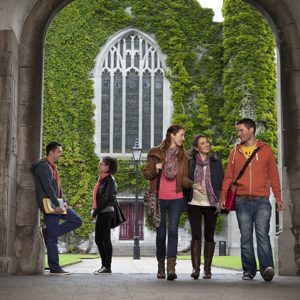
Choosing a course is one of the most important decisions you'll ever make! View our courses and see what our students and lecturers have to say about the courses you are interested in at the links below.
-
University Life
University Life
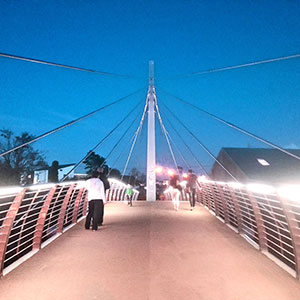
Each year more than 4,000 choose University of Galway as their University of choice. Find out what life at University of Galway is all about here.
-
About University of Galway
About University of Galway
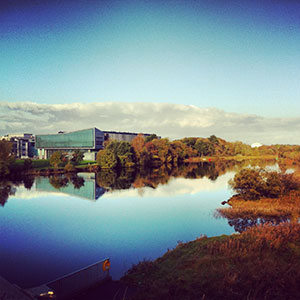
Since 1845, University of Galway has been sharing the highest quality teaching and research with Ireland and the world. Find out what makes our University so special – from our distinguished history to the latest news and campus developments.
-
Colleges & Schools
Colleges & Schools
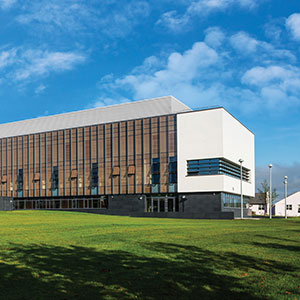
University of Galway has earned international recognition as a research-led university with a commitment to top quality teaching across a range of key areas of expertise.
-
Research & Innovation
Research & Innovation
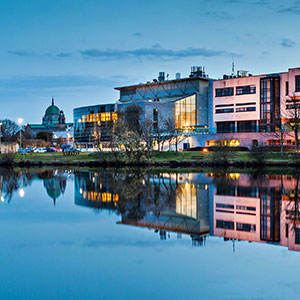
University of Galway’s vibrant research community take on some of the most pressing challenges of our times.
-
Business & Industry
Guiding Breakthrough Research at University of Galway
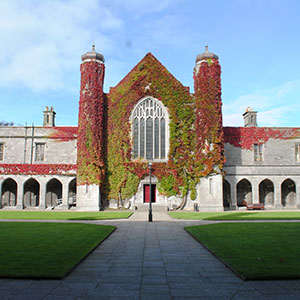
We explore and facilitate commercial opportunities for the research community at University of Galway, as well as facilitating industry partnership.
-
Alumni & Friends
Alumni & Friends
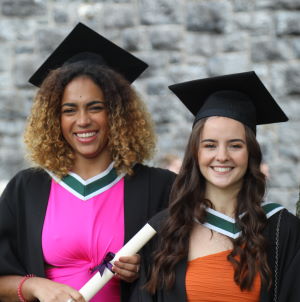
There are 128,000 University of Galway alumni worldwide. Stay connected to your alumni community! Join our social networks and update your details online.
-
Community Engagement
Community Engagement
At University of Galway, we believe that the best learning takes place when you apply what you learn in a real world context. That's why many of our courses include work placements or community projects.
 Accessibility & Language
Facilities
The Timber Engineering Research Group has access to a range of experimental and computational facilities at the University of Galway. These include timber testing equipment, strength grading systems, conditioning chambers, data acquisition systems, and advanced engineering analysis software.
Experimental Facilities
Dartec 500 kN Servo-Hydraulic Testing Machine
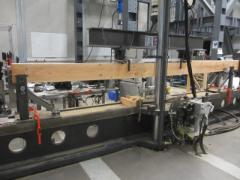
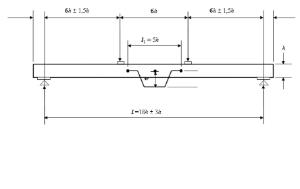
This is the primary testing machine in the timber laboratory. Key features include:
- 500 kN load capacity.
- Adjustable cross-head with ram travel of up to 3.5 m.
- 7 m test bed length.
- Interchangeable plates and loading frames.
- Load- and displacement-controlled testing.
- Tension, compression, shear, and bending test capability.
- Three- and four-point bending test capability.
- Dartec 9500 controller.
- Static and dynamic test capability.
Although purchased primarily for the timber laboratory, this machine is also used by researchers and undergraduate students in other areas of the School.
Dartec 250 kN Servo-Hydraulic Testing Machine
The Dartec 250 kN testing machine provides flexible testing capacity for a range of structural and material investigations. Key features include:
- 250 kN load capacity.
- Adjustable cross-head with ram travel of up to 1.5 m.
- Interchangeable plates and loading frames.
- Load- and displacement-controlled testing.
- Tension, compression, shear, and bending test capability.
- Three- and four-point bending test capability.
- Computerised data acquisition.
Timber Stress Grading Machine (Cook-Bolinder)
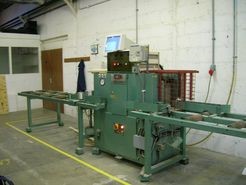
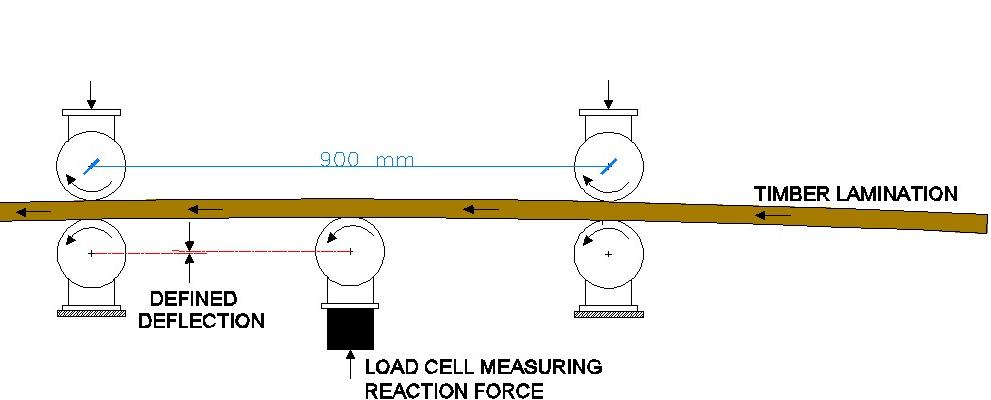
The timber laboratory includes a Cook-Bolinder stress grading machine. Mechanical strength grading is essential for selecting structural timber for construction and is fundamental to structural timber design.
Mechanical grading is faster than visual grading and is carried out by testing selected properties non-destructively. The procedure certifies that each timber piece has the required strength and stiffness characteristics for its intended application.
Under EN 14081-4, a pre-set deflection based on the species, board thickness, and board width is input into the grading machine. The load required to achieve the pre-set deflection is recorded for both sides of the board, and the mean value is determined for each location.
Key features include:
- Computerised rejection of boards that do not achieve the required structural grade.
- Computerised data acquisition.
- 900 mm test span.
- Third-point loading.
- Flatwise bending stiffness readings at 100 mm intervals.
- 3.5 m infeed and outfeed roller tables.
MTG Acoustic Timber Grader
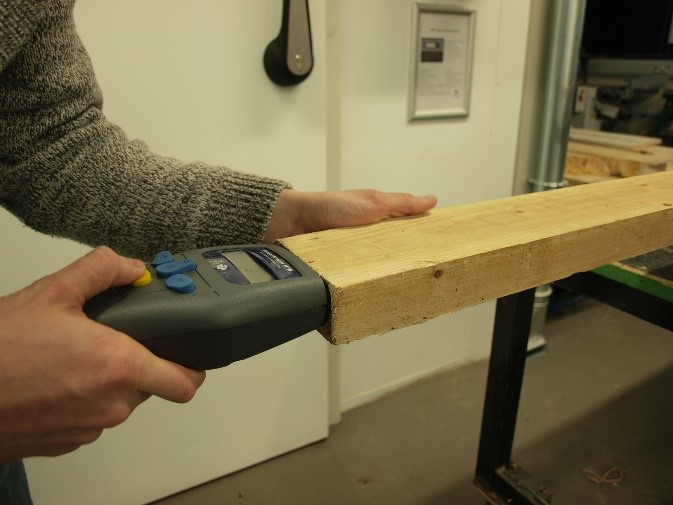
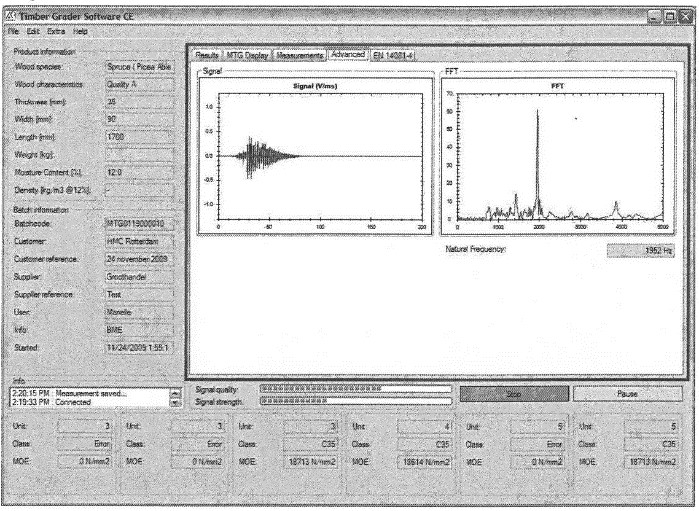
The MTG acoustic timber grader is a lightweight measurement device that uses acoustic measurement to estimate the strength class of timber boards based on dynamic modulus of elasticity and density.
Key features include:
- Timber Grader software for storage and reporting of measurement data.
- Integrated mass balance for accurate density measurement.
- Handheld device with Bluetooth communication adaptor.
- Calibration set.
Glue-Laminating Timber Press
The press was specially designed and fabricated to enable glued laminated timber beams to be designed and manufactured in the laboratory.
- Capability to produce beams up to 4.6 m long.
- Lay-up design based on Cook-Bolinder material data.
- 13.8 m2 preparation area with fume hood for adhesive application.
- Flatwise clamping pressure applied through two RHS steel sections in accordance with EN 14080.
- Edgewise clamping pressure to reduce warping or twisting of individual laminations.
Conditioning Chambers
The Timber Engineering Laboratory has two climate chambers. The constant climate chamber maintains a temperature of 20°C ± 2°C and relative humidity of 65% ± 5%, in accordance with EN 408. These conditions generally correspond to a nominal moisture content of 12% for softwoods. The variable climate chamber is used to examine timber elements under different moisture conditions.
Constant climate chamber
- Constant temperature and relative humidity control.
- Data acquisition for temperature and relative humidity.
- 37.6 m2 area.
- Durable racking to store members up to 7 m long.
- Easy access for deliveries.
Variable climate chamber
- Temperature control from 10°C to 40°C, with an accuracy of ± 2°C.
- Relative humidity control from 10% to 90%, with an accuracy of ± 5%.
- Data acquisition for temperature and relative humidity.
- 7.4 m2 area.
Computational Facilities
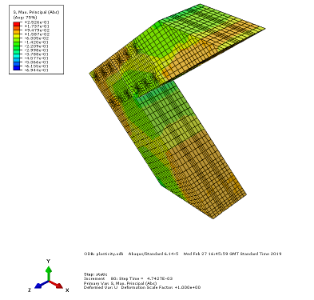
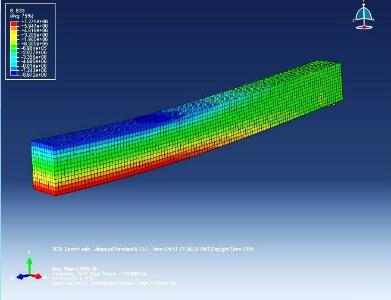
Computational facilities include hardware and software for data acquisition, advanced engineering analysis, and finite element modelling.
- State-of-the-art hardware and software for data acquisition and engineering analysis.
- Finite element software, including ANSYS and ABAQUS.
Finite element modelling of timber and engineered wood components requires specialist expertise. Timber is complex to model because of its anisotropic behaviour, natural variability, heterogeneity, and nonlinear characteristics. Finite element analysis is a valuable tool for predicting the structural behaviour and performance of timber components and supports safe, efficient structural design.